

Welcome to the Canadian PA Guide on PA Consortium
Last updated July 28, 2026
This is not an official University of Toronto BScPA Program resource. Information is updated when available, but always verify details on the Official Program Website.
PA PROGRAMS > ONTARIOUniversity of Toronto
Bachelor of Science in Physician Assistant Studies (BScPA)
The PA Consortium delivers the University of Toronto BScPA program in collaboration with NOSM University and The Michener Institute at UHN. Founded in 2008, with its inaugural cohort graduating in 2010.
-
Address:
BScPA Program, Temerty Faculty of Medicine
University of Toronto
500 University Avenue, 5th Floor
Toronto, ON M5G 1V7Email: physician.assistant@utoronto.ca
__
Update:
As of August 2026, the new address for the UofT BScPA Program is:840 Military Trail
Scarborough, ON
M1C 0C7 -
-
2 years
Duration
-

60 students
Class size
-

$11,500 CAD/year
Tuition
-

September
Start Date
-

Hybrid (Online & In-Person)
Format
-

Accredited by EQual
Accreditation Canada since 2023
APPLY TO PA CONSORTIUMPA Admissions Guide
PA CONSORTIUM > ADMISSIONSAdmission Requirements
 Resident Status
 Undergraduate Study
 Minimum GPA
 Prerequisite Courses
 Health Care Experience
To apply to University of Toronto’s PA Program, you must be a Canadian Citizen or Permanent Resident of Canada and have a minimum of 2 years of undergraduate study (~10 full year courses).
You also need a minimum cumulative GPA to apply is 3.0 at a 4.0 on OMSAS scale, which includes grades from all undergraduate study. There are no prerequisite courses you need to complete to apply.
Health Care Experience (HCE) Hours
Applicants are required to have a minimum of 350 hours of healthcare experience, which can be paid or unpaid. The website states that this can be obtained through employment, hours earned during clinical placements, or through volunteering.
Healthcare is evaluated based on the level of direct involvement with patients, specific clinical duties, level of supervision, total number of hours, type of clinical settings, and how recent the experience is where.
PA CONSORTIUM > ADMISSIONSPreferred Admission Criteria
University of Toronto BScPA outlines preferred admission requirements. This means that if you have any of these criteria or qualifications, your application would be considered more competitive.
Note: Having preferred criteria is NOT requiredto apply to the program. You can still have a competitive application without having any criteria. There are many examples of successful PA candidates who had none of the preferred admission criteria and were able to secure a spot.
This is helpful however, if you are planning to reapply and wish to add "more points to your application", you can consider taking additional coursework or gaining different types of healthcare experience. In summary, this is ‘nice to have’ but not necessary to get in.
PA CONSORTIUM > ADMISSIONSPA Admission Process
 Application Portal
 Supporting Documents
 REFERENCES
 Pre-Interview Assessments
 Final Interview
 Offers
 PROGRAM START
Step 1: OUAC
The first step in completing your UofT PA Online Application is registering through OUAC by January 15.
Step 2: Enable JOINid
About 5-10 business days after, you will receive an email that asks you to enable your JOINid giving you access to the admissions portal website. You’ll also receive a UofT applicant number.
Step 3: Send Supportive Documents
He will then submit supportive documentation, including transcripts for all completed undergraduate-level courses.
If English is not your first language, then you may need to provide proof of English language proficiency.
Step 4a: UofT PA Supplemental Application
The UofT PA supplemental application is split into two parts:
Part A: Supplemental Application
You’ll receive a link to Part A 5-7 business days after receiving your UofT applicant number from Step 2. This usually includes describing your health care experience in more detail.
Part B: Kira Talent: Online Written Assessment
You’ll also receive an invitation to complete Part B, an online written assessment where you’ll answer questions using the Kira Talent Platform.
Step 5: Multiple Mini Interviews
Competitive applicants are invited to a virtual Multi-Mini Interview, made of a series of stations where you answer questions that will assess communication, cultural sensitivity, empathy, leadership and critical thinking skills. Invites are sent 2 weeks in advance.
Offers of Admission
Acceptances to successful applicants are sent in late May (this was May 23 in 2025). Students who accept their offer of admission then submit medical information including proof of immunizations, a police check. You also complete an online course called “Orientation to the PA Program” ( (6 weeks in July and August) prior to program start.
PROGRAM OVERVIEWAbout PA Consortium
About
University Degree
 Location
 Length
 Delivery
The University of Toronto’s Bachelor of Science Physician Assistant (BScPA) Program is a full-time, competency-based professional degree designed to prepare students to become safe, ethical and competent physician assistants. The program is delivered collaboratively by the University of Toronto, the Northern Ontario School of Medicine and The Michener Institute of Education at UHN.
Year 1 is primarily delivered through distance education, with scheduled campus blocks that bring students together for in-person clinical skills training, simulation activities and assessments.
In Year 2, students transition into supervised clinical clerkships across Ontario, where they gain hands-on experience under the supervision of physician and physician assistant preceptors.
The program uses a competency-based curriculum aligned with the National Competency Profile for Canadian Physician Assistants (CanMEDS-PA) and the Canadian Entrustable Professional Activities (EPAs-PA). Throughout the program, students are assessed across the seven CanMEDS-PA roles and are expected to demonstrate competency in all 12 EPAs required for entry-to-practice.
PA CONSORTIUM > AboutYear 1: Pre-Clerkship
Year 1 builds the medical knowledge and clinical skills needed for clinical practice in Year 2. Students complete core science courses including Anatomy, Physiology, Pathology and Pharmacology, while progressing through three Clinical Skills courses focused on history taking, physical examination, clinical reasoning and patient management.
\Behavioural Medicine and Diagnostic Techniques and Procedures (DTP) further develop the skills needed to assess patients safely and perform common clinical procedures.
Students begin developing clinical experience early through Longitudinal Clinical Experiences (LCEs), where classroom learning is reinforced through supervised patient care.
Throughout the year, students return to Toronto for two intensive campus blocks that focus on hands-on skills training, simulation and Objective Structured Clinical Examinations (OSCEs).
PA CONSORTIUM > AboutYear 2: Clerkship
In Year 2, students transition from the classroom into supervised clinical practice, where they apply the medical knowledge and clinical skills developed during Year 1 in real healthcare settings.
Clinical Rotations
Students work under the supervision of physician and physician assistant preceptors, gradually building clinical reasoning, procedural skills and professional confidence through direct patient care.
The clinical year is organized into three sequential clerkship courses comprising 8 to 10 clinical rotations, including both core and elective experiences across a variety of medical specialties. Students complete an End of Rotation Examination(EOR) following each rotation, in addition to ongoing workplace-based assessments completed by their clinical preceptors.
Resource: The UofT BScPA Clinical Handbook outlines rotation expectations in more detail (e.g. Overview, what to expect in the clinical placement, work & call schedules, EOR exam)
N-S Swap Training Locations
Students complete a minimum of three 3 Northern Hub placements considered for learners with a strong interest in the region. Click here to view a map of Clinical Site Locations.
Concurrent Courses
Alongside clinical training, students continue online coursework that supports their development as entry-to-practice PAs:
Medical Foundations II: Integrates advanced pathophysiology and clinical reasoning through increasingly complex patient presentations.
PA Scholar: Focuses on evidence-based medicine, critical appraisal of the literature and quality improvement to support clinical decision making.
Health Promotion and Education: Explores health promotion, disease prevention and patient education from both individual and population health perspectives.
Medical Ethics: Develops ethical reasoning and professional decision making through the exploration of ethical principles and clinical scenarios.
Year 2 Campus Block
Students also return to campus during the clinical year for a second Campus Block, where they participate in in-person learning activities, simulation and standardized competency assessments, including Entrustable Professional Activities (EPAs) and Objective Structured Clinical Examinations (OSCEs).

PA CONSORTIUMPost-Graduation
Step 1: Certification as a Physician Assistant
Graduates of University of Toronto’s PA program are eligible to challenge the Physician Assistant Certification Examination (PACE) through the Physician Assistant Certification Council of Canada (PACCC).
Successful completion of PACE allows graduates to use the Canadian Certified Physician Assistant (CCPA) designation, which is the national certification credential for PAs in Canada.
Step 2: Register to Practice
PAs can practice in Canadian jurisdictions where the profession is regulated and recognized.
PAs are regulated in Ontario, and must register with the College of Physicians & Surgeons of Ontario (CPSO) to practice in this province. Graduates planning to work in another province or territory must complete the registration process through the appropriate regulatory authority in that jurisdiction.
Step 3: Begin Clinical Practice
Once certified and registered, PAs can work across a wide range of healthcare settings and specialties, depending on provincial regulations, employer needs, and the individual PA/MD supervisory relationship
APPLY TO PA CONSORTIUMApplicant Resources
-
01. Pre-PA Community Chats
-
02. Application Prep Guides
HEAR FROM PA STUDENTS & ALUMNIUofT PA Podcast Interviews
WITH UofT PA GRADUATES

WITH UofT PA STUDENTS




UNIVERSITY OF TORONTO BScPA PROGRAM
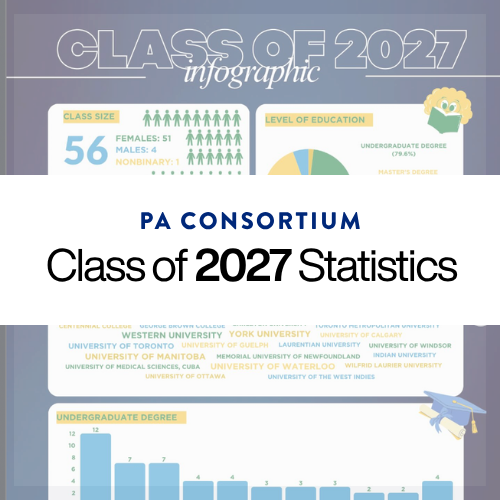
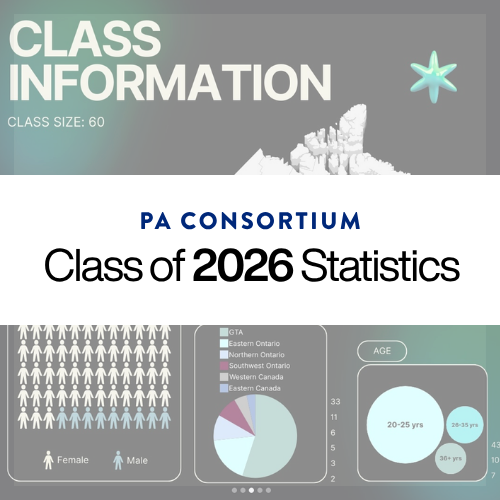
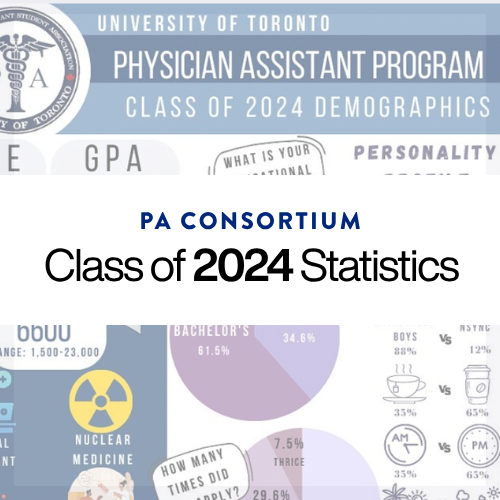
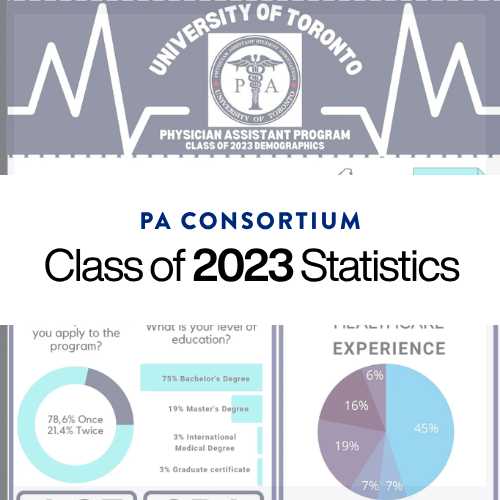
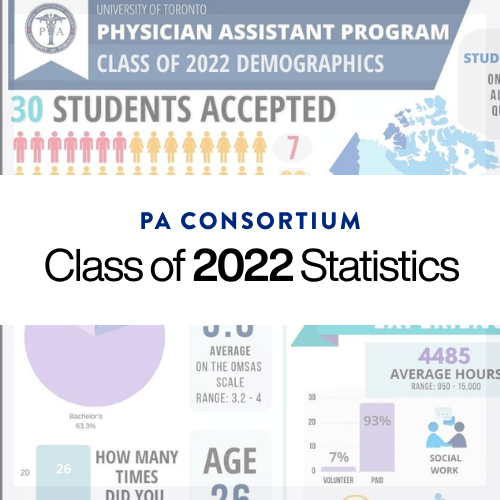
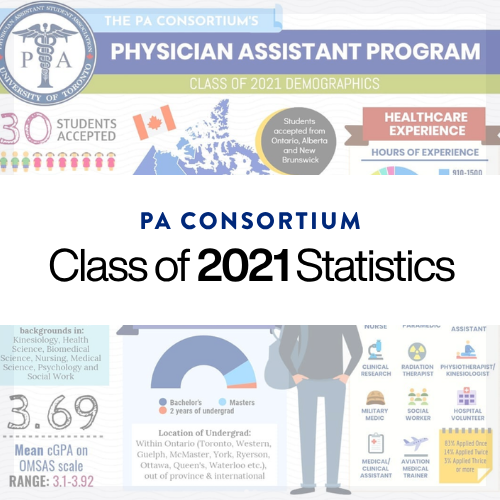
Accepted Class Statistics
Each year, the current PA class provides a snapshot of their cohort’s unique journeys to the PA Profession! Statistics include GPA, academic background, hours and source of healthcare experiences and more. Posts are created by current students, and is not reflect the UofT BScPA Admissions Process.
Inside Liver Transplant Medicine: A PA’s Role in High-Acuity Care