Episode #12: Aurthi, UofT PAS1
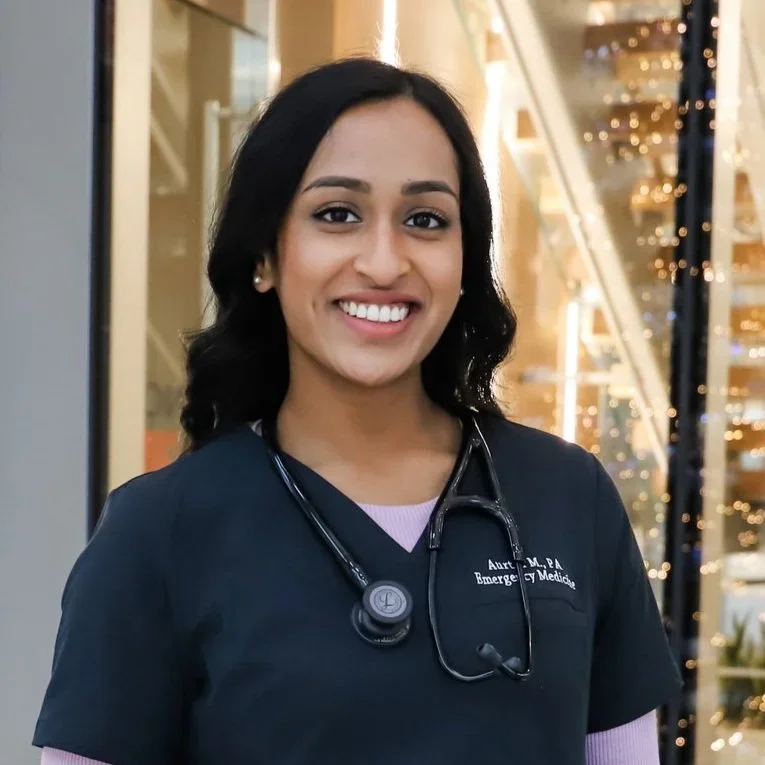
In this episode, I speak with Aurthi, a first year Physician Assistant student at the University of Toronto. She walks through her path from studying kinesiology and medical sciences at Western University to discovering the PA profession and deciding to pursue it instead of medical school.
Aurthi explains how she built patient care experience through volunteering, working as a kinesiologist in physiotherapy clinics, and serving as a medical assistant. We also discuss GPA expectations, healthcare experience requirements, and the differences between applying to Canadian and American PA programs. She also describes what the first year of PA school at UofT looks like, including residential blocks, online learning, clinical experiences, and study strategies that helped her stay organized in an accelerated program.
WHAT YOU’LL LEARNHow to build meaningful Pre-PA health care experiences
How to balance varsity athletics, leadership roles, and academic performance during undergrad
What factors influence the decision to choose PA school over medical school in Canada
GUEST BIOAurthi is a first-year Physician Assistant student at the University of Toronto. She completed her undergraduate studies at Western University in Community Health and Medical Sciences, where she built a strong foundation in anatomy, physiology, and pharmacology while balancing a wide range of leadership and extracurricular roles. During her time at Western, she captained the varsity tennis team, contributed to cultural and student support initiatives, and engaged in community-based volunteering across clinical and non-clinical settings.
Her path into healthcare was shaped by early and diverse exposure to patient care, beginning in high school volunteer roles and continuing through placements in hospitals, retirement homes, and physiotherapy settings. After graduation, she worked as a kinesiologist in clinical rehabilitation environments, gaining hands-on experience supporting patient recovery, delivering exercise therapy, and working in multidisciplinary outpatient settings. She also gained additional clinical exposure as a medical assistant in family and walk-in clinics, where she developed experience with patient intake, communication, and care coordination.
Aurthi’s decision to pursue the PA profession was driven by extensive self-directed exploration, including shadowing experiences across surgery, oncology, and neurosurgery, as well as a strong interest in flexible, team-based clinical practice. She is currently in the didactic phase of her PA training, balancing online learning with residential clinical skills blocks and longitudinal clinical placements. Her academic and clinical journey reflects a consistent focus on adaptability, curiosity, and thoughtful career alignment within Canadian healthcare.

ON FLEXIBILITY OF PA SCOPE OF PRACTICE“The PA's role is very flexible and that's what makes it super unique—you don't have that set scope of practice. For someone who likes variety, that's something that's intriguing.”
— Aurthi, 1st year UofT BScPA Student
ON PREPARATION & REST DURING 1st YEAR PA SCHOOL“After my first semester of PA school, I learned that you need to utilize your break times as much as possible because you recharge and you're able to tackle the new semester. You literally just hit the ground running.”
— Aurthi, 1st year UofT BScPA Student
CONNECT WITH THE CANADIAN PA COMMUNITY“A is a growing profession, so networking is key. Sometimes even on Instagram through hashtag searches, you can find PA students and just start a conversation. Ask your questions and say hi.”
— Aurthi, 1st year UofT BScPA Student
ON STUDYING ON IN PA SCHOOL“Start with broad brush strokes and then focus on the fine details. That way you don't feel as overwhelmed. You step back and look at the big picture while also focusing on the small things.”
— Aurthi, 1st year UofT BScPA Student
ON STAYING CONNECTED BETWEEN RES. BLOCKS“November is the loneliest month because you're used to being with classmates, but then online learning sets in. That's why staying connected with your cohort and taking breaks for social support is so important.”
— Aurthi, 1st year UofT BScPA Student
-
Trailer
Aurthi[0:00] I literally just Googled "a career in medicine that's similar to a doctor but shorter schooling." The program at Manitoba actually showed up and I was like, no, this can't be real. And I kept looking into it. I was like, this can't be real, this is so good, this is too good to be true. And then I called my mom and she said, no, that's not possible.
Aurthi[0:16] I've never seen a PA. And I did more research and found more schools in the States as well as in Mac. I'm not applying to Med anymore because this has been what I wanted. The more I researched about the profession, the more I wanted to do it, which I didn't feel the same for medical school personally.
Anne[0:31] If you were trying to decide whether the PA profession is right for you, this episode will give you real insight. Welcome to the Canadian PA Podcast.
Intro
Aurthi[0:39] Hi, I'm Aurthi. I'm a first-year PA student at the University of Toronto. I did my undergrad at Western University in Kinesiology and Medical Sciences, and I took a lot of science courses. I think it provided a good foundation for PA school — especially first semester with anatomy and physiology, and second semester it's helping with pharmacology as well. It's a good program to be prepared from.
Aurthi[0:54] For my extracurriculars, from first year to fourth year I was part of the Western tennis team, and in fourth year I actually captained the team. That year we won the OUA, which was very special. I did two mission trips with Habitat for Humanity — we went to Thibodaux, Louisiana, and helped with rebuilding houses after Hurricanes Sandy and Katrina. I was VP Internal as part of Ethnocultural Support Services, where we organized events raising awareness for cultural diversity. Other extracurriculars included volunteering at a local walk-in clinic, tutoring at Oxford Learning, and coaching at a university tennis club.
Building Diverse Patient Care Experience for PA School
Anne[1:50] How did you approach volunteering? Did it begin in university or in high school?
Aurthi[1:55] It began in high school, grade 9. We had the 40-hour requirement to graduate and I started volunteering at a retirement home, then moved on to Joseph Brant Hospital — starting in the gift shop, then the ICU, and eventually day surgery. I started using those volunteer experiences to navigate different career options. I also volunteered at a physiotherapy clinic to see if kinesiology would be a good undergrad option. I enjoyed spending time with different patient populations — seniors at the retirement home, a wide range of ages at the hospital, and athletes at the physiotherapy clinic.
Anne[2:40] Were you taking on leadership positions right from the beginning, or did you build up to that?
Aurthi[2:44] I built up to it. First I was trying to get oriented with my academics, and then as I got comfortable with my learning style and how to study efficiently, I got more comfortable adding on extracurriculars. Third and fourth year I took on more leadership roles. A good example is tennis — as captain I had more duties, had to make sure the whole team was happy and healthy and fit to compete, and I worked with the coach on lineups and discussing each player's strengths and weaknesses.
Anne[3:23] Can you tell us a little bit about your healthcare experience hours?
Aurthi[3:26] Most of my healthcare experience hours came from working as a kinesiologist after graduating. I worked at two physiotherapy clinics where I set up patients with treatment modalities — ultrasound, TENS — but also taught them exercises. At one clinic, the gym was my office. I worked with multiple patients, made sure their form was correct, and progressed them to harder exercises as they recovered. It was really rewarding to see them go through that recovery process.
Aurthi[4:06] Aside from that, I volunteered at a family health clinic close to home one summer, and the following summer I was hired there as a medical assistant to complete patient profiles. A lot of those patients were ESL, so I had to find alternate modes of communication — that challenged me in a different way. There was also a walk-in clinic close to university, near the more rural and downtown areas of London, where I did about four to eight hours weekly. The population was different there, which gave me broader exposure.
Anne[4:44] How did you get the kinesiology job opportunity?
Aurthi[4:48] It was an interesting story. After graduating, I couldn't find a job for two months. I actually did an Explorer program and even throughout the five weeks I was there, I didn't hear back. Kinesiology is a competitive field because volunteers can do some of those duties. It was actually July when I was playing tennis and my future boss's husband was on the other side of the net. He overheard me mention my kinesiology degree and that I was job searching. He said, "My wife is looking to hire." I submitted my resume, went for an interview, and that's how it started. For other clinics, I just applied, followed up as much as I could, and used my network — like asking at my mom's family doctor's office if there were any opportunities.
Anne[6:12] What's your tip for pre-PAs trying to diversify their experience?
Aurthi[6:16] The main tip I'd give is: there is no right way. That's a common question I get from pre-PAs — "What should I do to make my application stand out?" There's no magic recipe. Do what interests you, and you'll shine in that field. The passion shows when you talk about it at interviews. In our class, we have paramedics with 23 years of experience, sleep techs, medical assistants, nurses who chose PA over nurse practitioner. Everyone has a different story, and everyone's healthcare experience played a role in getting them there.
Improving Academics and Study Techniques in Undergrad
Anne[7:02] What was your GPA?
Aurthi[7:03] My cumulative GPA was 3.61. I started off really low — I overloaded my first three years because I wanted to add a minor in Medical Sciences. First year I was around 3.4, and then fourth year I finished with a 3.83. I showed my ability to understand my learning style and study efficiently while balancing extracurriculars. This speaks to the point that you don't have to have a 4.0 GPA to get into professional school. As long as there's progression, or you can balance extracurriculars with a solid GPA, it still makes you a strong candidate.
Anne[7:50] How did you maintain that balance to keep your grades up?
Aurthi[7:52] I'm the type of person who likes to go, go, go. So I scheduled breaks — a tennis practice before studying, a workout, hanging out with a friend or roommate. Those small breaks helped me accelerate the time slots I had for studying. I love variety. I don't like sitting for ten hours and studying continuously. I take a break in between, which is something I try to maintain from undergrad into PA school.
Anne[8:26] Were there major differences between what you did in the first three years versus fourth year?
Aurthi[8:30] First year, I tried to maintain my high school study techniques — mostly rote memorization — and that was definitely difficult because there was a lot more content in less time. I was also surrounded by a lot of Medical Sciences students from IB programs with strong study skills, so I tried to learn from my peers and experiment with different techniques. By fourth year, I found what worked for me. I started writing concepts out, summarizing as I went, and using a whiteboard to draw out different pathways. That whiteboard was probably my best purchase in fourth year.
Aurthi[9:19] In PA school, I got into group study, which is something I wasn't doing much in undergrad. We use Blackboard's online platform — everyone logs on and we use a blank whiteboard together, upload PDFs, and test each other on concepts. Sometimes we ask someone to explain a concept, then have them repeat it back in their own words. Depending on where you are in the learning process, at first you're explaining concepts to each other, and the day before an exam you're drilling questions. It's amazing how something a classmate tells you the night before shows up on the exam.
Why Aurthi Chose Physician Assistant Over Medical School
Anne[11:19] How did you figure out what you wanted to do, and how did you get to PA?
Aurthi[11:23] In high school I was focused on life sciences and initially on medical school. Then I switched to kinesiology last minute because I thought the anatomy and physiology foundation was good for any career in medicine. I kept exploring. By third year I thought, okay, maybe it is medicine. I applied to med school, took the MCAT. Even then it was half-hearted — I had concerns about the years of schooling, the finances, the work-life balance during and after. I was still looking for other options.
Aurthi[11:45] Then between second and third year, I literally just Googled "a career in medicine that's similar to a doctor but shorter schooling." The Manitoba program showed up and I was like, no, this can't be real. I called my mom and she said the same thing. By fourth year, after doing more research and finding programs in the States and at Mac, I said this is what I'm doing. I'm not applying to Med anymore.
Aurthi[12:45] I initially applied to American schools because I was a bit hesitant — the profession wasn't as established in Canada yet. But then I came across your page and learned about the trailblazers for the profession here, and I thought, I love this profession so much that I want to be part of building it in Canada. I did get an offer at a university in New York. When I went to the interviews, I realized the tuition was quadruple, and there were a lot of lifestyle adjustments — health insurance, everything else. So I decided to stay close to home. Then I had to choose between Mac and UofT, which was a really tough decision.
Aurthi[13:38] Every time I get stuck on a big decision — Med versus PA, Mac versus UofT — I make a pros and cons list and take time to reflect on what I want, both for my career and in terms of my learning style. That's how I ended up at UofT. I also applied to Manitoba, but one course stopped my application early — biochemistry. For the US, I tried to narrow my universities because there are over 170 you can apply to. The GRE was a major requirement for a lot of them, and I didn't take it straight out of undergrad, so that limited my options.
Learning the Flexible PA Role Through Observerships
Anne[14:40] Did you do any PA shadowing or observerships before school?
Aurthi[14:44] I did it during my year off between undergrad and PA school. I was curious about what a PA actually does day-to-day — you can read about it, but seeing it in person is different. I eventually found the observerships offered by UHN and got three placements: general surgery at Toronto General, then radiation oncology, then neurosurgery. My first preceptor in the radiation oncology placement told me about her experience at UofT. I also went to see Maitri in her role, and heard about the McMaster experience. Hearing different perspectives and seeing what PAs do across specialties was really valuable.
Anne[15:42] Was there a big difference between what you read about being a PA and what you saw in person?
Aurthi[15:46] It varies based on the setting and who you're working with. If a PA had more residents or fellows on the team, there was probably less for them to do in terms of direct patient care, but they were filling in the gaps elsewhere. If you were part of a smaller team with fewer residents and fellows, you had more to do. When I was reading about it, it seemed like there was almost a set scope of practice. But one of the key things I took away is that the PA role is very flexible — and for someone who likes variety, that's what makes it so intriguing.
Anne[16:23] What advice would you give to people who can't seem to secure an observership?
Aurthi[16:30] Educate yourself about the profession in any way you can. There are YouTube videos, Instagram pages — that's actually why I started my own page, just to advocate for the profession and show what we do. If you can't get an observership, there are other means. Reach out to PA students or practicing PAs and just ask them what their day looks like. It doesn't have to be in person — sometimes just hearing about it changes everything. Networking is key. Instagram is actually a good platform for finding PAs through hashtag searches, which is how most pre-PAs reach out to me.
Inside First-Year PA School: Residential Blocks and Online Learning
Anne[17:46] Where are you in your PA education right now?
Aurthi[17:47] I started in September, so I'm about five to six months in, roughly halfway through second semester. I have one more semester running through the summer until end of August, and then second year, which is the clinical year. So I'll finish my didactic year and then dive into clinical rotations before graduating.
Anne[18:11] There's a misconception that UofT's PA program is 100% online. Can you explain how first year actually works?
Aurthi[18:17] Most of it is online, but there are residential blocks where everyone in the program — wherever they are geographically — comes to Toronto for in-person sessions. Most of those sessions are focused on clinical skills, because you want to learn physical exam skills hands-on. But there are also intro sessions for courses and wrap-ups at the end of semesters. The September res block was four weeks. December was about a week and a half. April we have one coming up for about two weeks, and then July through mid-August is our last res block.
Aurthi[18:51] During res blocks, you meet with program directors for feedback, get updates on how things are going, and start setting up clinical rotations. The online learning in between fills the gaps — it's mostly self-directed. You're given a set number of lectures to complete on your own time, which is great because you can schedule your own day. Tuesdays are allocated for LCEs every week. You also have weekly course meetings — through class discussions or quizzes — to make sure you're staying on track. Online learning is probably when most students fall behind, but the in-person portions let you reconnect with classmates.
Anne[19:58] And tests — how do those work?
Aurthi[20:01] Quizzes are done online at home. But tests you actually go to a proctor site. For people close to Toronto, we go to a building on campus and take the test in person, with a professor or TA running it. For students further away, the program coordinator approves a local proctor site near them. Sometimes it's five minutes from home, sometimes they need to drive. There's a lot of flexibility and the program tries to make it work for everyone.
Anne[20:35] For students outside the GTA, what arrangements do they typically make for four-week residential blocks?
Aurthi[20:43] Airbnb is the most common option. From the September res block to December, people started pairing up with classmates to share a place close to campus. They try to book early to save money. Since most of the program is online and students are at home for that, the res block accommodations are really the main logistics to figure out.
Anne[21:09] Is res block structured like a typical 8-to-4 workday every day?
Aurthi[21:14] Every day is different. Sometimes we have really long days starting at 8 and finishing at 5. Other days we might start at 9:30 or 10 and finish at 3:30. Most days include clinical skills, but some days have feedback lunches or curriculum committee meetings mixed in. There's no fixed schedule per se. They usually post it before the res block starts so you can plan ahead.
Anne[21:44] What was the focus during the December res block specifically?
Aurthi[21:47] The major focus was clinical skills — specifically the female and male pelvis exam and the biopsychosocial module. We'd learn the content one day and then the next day work with standardized patients. The clinical skills exam at the end included an ePBL and assessed specifically what we learned during that block. We also got an introduction to the rational prescribing framework in person, which lent itself better to face-to-face conversation. We had curriculum committee meetings, feedback sessions, and mock OSCE-style practice where you had to perform the physical exam on a classmate and verbalize your steps out loud. It was pass/fail, but great practice.
Anne[23:03] You took a course on PA status and role in Ontario — what did you enjoy about it?
Aurthi[23:08] That course was called "PA Status and Role" — taught by Denise — and I really enjoyed it. It gave a strong foundation in the PA profession: funding, regulation, the economics of healthcare, how the system works. We had guest lecturers come in, which was great. The assignments were creative — one was a PA profile where you film yourself talking about the profession with a personal touch. I did mine as a mock job interview format. We also had a lot of discussion posts and a final opinion editorial where you chose a topic like "why PAs need to be regulated" or "why the healthcare system needs to fund more PAs." You did research, developed a position, and wrote it up. It was self-directed learning that actually made you think deeply about the profession.
How LCEs Work: Longitudinal Clinical Experiences at UofT
Anne[25:25] You have a class called LCE — how does that work?
Aurthi[25:28] LCE is Longitudinal Clinical Experience, similar to McMaster's LPs. We're expected to do 30 to 40 hours max in a clinical setting each semester. Certain semesters have specific requirements — for example, 10 hours must be in primary care, which includes family medicine and emergency medicine. You reach out and network to find placements from a database of preceptors who have taken students before. Tuesdays are fully allocated for these placements. Some days are four hours, but when I did general surgery it was 7:30 AM to 5:30 PM — long days, depending on the specialty.
Anne[26:39] Is it just observing, or are you expected to do more?
Aurthi[26:39] It depends on the placement. For my paramedic experience, it was mostly observational, but I had a lot of discussions with the paramedics about their thought process in emergent situations. For those experiences, I wrote a reflection — what my goals were going in, what I learned, what I found challenging. For more clinical settings like general surgery or family medicine, I wrote SOAP notes. First semester it was four SOAP notes and one reflection. This semester it's three SOAP notes and two reflections, so there's more flexibility. I also did the coroner's office, which was another interesting experience that lent itself more to reflection than a SOAP note. The SOAP notes started with a basic framework and progressively included more differential diagnoses — from five to ten — over the semester.
Managing a Typical Week and Study Schedule in PA School
Anne[28:01] Can you walk us through a typical week of non-residential online learning?
Aurthi[28:05] Every week is different and every semester is different. First semester: Mondays were mostly free. Tuesdays were for LCEs. Wednesdays were physiology — we had a physiology meeting plus clinical skills in the morning. Fridays were anatomy meetings. This semester it's busier. Mondays have pharmacology, usually starting with a quiz, then lecture, then pathology — which is dense even though it's just one hour — followed by another quiz. So Mondays are heavy this semester.
Aurthi[29:34] For pathology, I personally split the lecture material with my study group. If there are 24 lectures and six of us, each person covers four lectures. You review together, prepare for the pathology meeting, and explain the concepts to each other. Tuesdays are LCE placements. Wednesdays are free this semester. Thursdays are clinical skills, which this semester is more discussion-based — you facilitate the conversation rather than present a specific learning objective. Fridays are DTP — Diagnostic Techniques and Procedures — where we go through readings and case studies focused on investigations, with multiple choice quiz questions through the Blackboard app. Weekends are open, so I schedule studying in the morning and assignments or case workups in the evening, with a workout or lunch break midday to compartmentalize.
Aurthi[31:14] There's also interprofessional education, or IPE. Throughout the two years you complete core activities that everyone attends and a minimum of two elective activities. The core ones are online or during res blocks. I've met physiotherapists, medical students, speech-language pathologists, dentists, and pharmacists — we do case studies together and everyone contributes from their own professional perspective. It's interesting to learn about each discipline's strengths and their approach to patient care. The elective activities I've done include one on death and dying and one on exercise prescription, based on my kinesiology background.
Anne[32:39] Is there a way you all stay in touch throughout the online portions?
Aurthi[32:42] For sure. First semester they say November is the loneliest month — September everyone's together, October you're settling into online learning, and then November is a bit of a low before December res block. This semester I try to meet up with classmates who are geographically nearby. A few days ago I spent time with a classmate from Oakville. It's important because your classmates are the only ones who truly understand what you're going through. Online, we message each other on Facebook, check in, do video chats. Making time for those connections is genuinely important when you're in such an accelerated program.
Anne[33:46] Do you have any contact with second-year students?
Aurthi[33:49] Yes. When I got my acceptance, I received a phone call from a second-year student — you're paired with a PA buddy who welcomes you in and answers questions over the summer. I've also been close with the second-year class rep. As the first-year class rep, I talk with him a lot about how to prepare for curriculum committee meetings, and he always checks in after exams. It's super supportive and comforting to have those mentors. I also keep in touch with PA graduates from both UofT and Mac to get a sense of what it's like in the real world.
Preparing for PA School: Summer Before First Year
Anne[35:18] For those who get accepted, what advice would you have for the summer before first-year starts?
Aurthi[35:26] There are two types of people: those who like to prepare during the summer, and those who make the best of their last few weeks of rest before school starts. After first semester, I learned that you should absolutely use your break times because you come back recharged and better able to tackle the next semester. If you're going straight from undergrad, finishing in April and starting in September, please rest. If you've been working for a year or two, feel free to skim through first-semester material like anatomy and physiology to brush up. You also have a medical terminology course over the summer to get familiar with the online platform, and although it's not graded, it helps ease you in. But strongly take the last couple of weeks before school starts completely off.
Anne[36:45] Any tips on staying on top of the study material?
Aurthi[36:50] I personally use checklists — a checklist of everything I need to complete for each course on a weekly basis, then on Sunday I build out my weekly calendar and allocate tasks to different days. A classmate suggested a "work day" approach where you study 8 AM to 5 PM and take evenings off. I modified that — I study from 7:30 to noon, then take about three hours off for the gym and lunch, then continue into the evening and finish around 8:30 or 9. Whatever works for you. The key is making those breaks intentional and consistent.
Anne[37:48] How do you tackle things like pharmacology or learning medications, which can feel overwhelming?
Aurthi[37:51] It varies by course and by concept. Medications are genuinely hard at first — some of those drug names I couldn't even pronounce. Mnemonics and abbreviations help. For disease processes in pathology, I like to start with broad brush strokes and then focus in on the fine details. If you start at the granular level, you lose the big picture. For differentials in clinical skills, I think of the system first — if it's a lung problem, consider fluid buildup, foreign body, pneumothorax — and then I use resources like UpToDate and PubMed to dig deeper. We also got a tutorial during September res block on using online databases effectively, which was really helpful.
Comparing Canadian and American PA School Applications
Anne[39:27] You also document your journey publicly — tell us about that.
Aurthi[39:32] I started with an Instagram page initially thinking I'd document my transition from kinesiology into PA school. It's been very focused on PA advocacy because of all the eager pre-PAs reaching out with questions. I started writing long Instagram captions and eventually thought, why not start a blog? And then videos came about because a friend in med school and I both kept getting the same question: why did you choose PA over MD, or vice versa? So we collaborated on a video comparing the two paths — application process, typical day, admission requirements, lifestyle factors — just from our own perspectives.
Aurthi[41:05] Feedback has been really positive. Classmates find it interesting to see a summary of what's happening in the program, and I think it encourages them to reflect on their own experience. I also run a UofT PA Class of 2020 profile series on the page where I asked classmates to share why they chose the PA career, advice for pre-PAs, and how they found online learning and first semester. Pre-PAs respond really well to hearing different perspectives. The messages I get from people saying they found the page useful and asking questions — that kind of positive feedback keeps me motivated to keep going.
Anne[42:06] Can you speak to some of the differences between applying to American versus Canadian PA schools?
Aurthi[42:10] The profession is more established in the US and there are many more schools — similar in that they use a centralized online platform like CASPA, comparable to the Ontario application system. The requirements are similar: academic background, personal background, healthcare experience. As a Canadian applicant, I had to get my transcripts evaluated through WES to confirm my degree was equivalent. Many American universities also required additional essays beyond the personal statement — for Rutgers, I had to write five separate essays tailored to that school's mission and values. So it's a lot more research and a lot more writing for each school.
Aurthi[43:16] The timeline is also different. American schools use rolling admissions, so the earlier you apply, the better. I submitted my US applications in May. For Canadian schools, you start in late fall, primary applications are typically due in January, supplementals come in February, and interviews run April to May. The key difference in writing is that US personal statements are longer, more narrative and creative — mine started with a story about getting a shoulder injury on the tennis court and how that sparked my interest in the human body. The Canadian supplemental applications are more focused, more concise, with specific questions. Different style, same goal: show who you are and why you want this.
Anne[43:58] What about the GRE — is that required?
Aurthi[44:02] The MCAT wasn't required for the schools I applied to in the States. But the GRE was required for most of them, which definitely limited my options. I applied to seven schools. Comparing that to the process for US med school, where some students apply to 20 or more, you can see how the GRE narrows your pool significantly if you haven't taken it.
Anne[44:28] As a Canadian applying to American PA schools, was there anything unique you had to do?
Aurthi[44:33] The WES transcript evaluation was the big one — confirming that my Canadian degree and courses translated to American equivalents. Sometimes you'd have to call a school and ask if a specific course counted as their equivalent to organic chemistry, for example. The personal statement was also structured differently. For American schools, you want to be creative and draw the reader in. For Canadian supplemental applications, you want to be clear, succinct, and get to the point. Both matter — but the craft is different.
Anne[45:42] If this episode was helpful, subscribe to the Canadian PA Podcast so you don't miss any upcoming conversations with students and PA graduates across Canada. See you in the next episode.