Welcome to the Canadian PA Guide on Manitoba MPAS
Last updated July 26, 2026
Note: This is not an official Manitoba MPAS resource. Information is updated when available, but always verify details on the Official Program Website.
PA PROGRAMS > MANITOBAUniversity of Manitoba
Master of Physician Assistant Studies
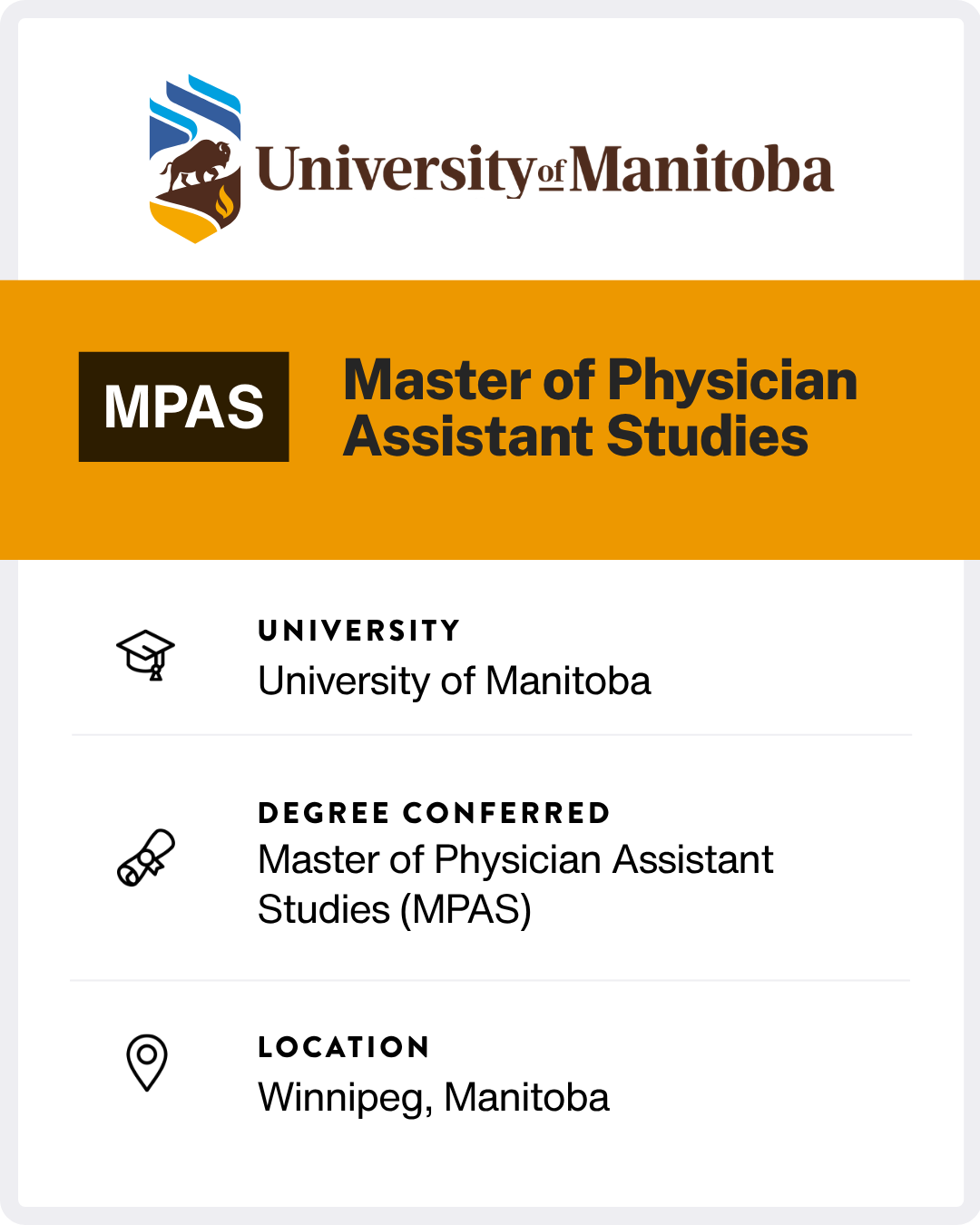
The University of Manitoba Master of Physician Assistant Studies (MPAS) is Canada’s first graduate-level PA program, offering 25 months of training that combines classroom learning with hands-on clinical rotations across different areas in medicine. Since launching in 2008, this program has shaped PA education standards across Canada and recently doubled its class size to 30 students, making it more accessible for people pursuing this career path.
-

2 years
Duration
-

30 students
Class size
-

$12,000 CAD/year
Tuition
-

September
Start Date
-

Full Time, In-Person
Format
-

Accreditation
Pending. Learn more
APPLY TO MANITOBA MPASPA Admissions Guide
MANITOBA MPAS > ADMISSIONSAdmission Requirements
 Status
 Undergraduate Study
 Minimum GPA
 Prerequisite Courses
 Health Care Experience
You must be a Canadian citizen or permanent resident of Canada to apply to Manitoba MPAS.
You need a completed four-year bachelor’s degree (or equivalent) from a recognized college or university. Applications are also accepted from students currently in their fourth year of study, so you can apply before graduation if you’re on track to finish.
Your GPA is calculated based on your most recent 60 credit hours of study, which can be full-time or part-time coursework. You need a minimum GPA of 3.0 on a 4.0 scale (approximately 75%)
No health care experience is required to apply.
Required Courses
Three courses are mandatory prerequisites and must be completed at the undergraduate level:
Human Anatomy (minimum 3 credit hours, B-level or higher)
Human Physiology (minimum 3 credit hours, B-level or higher)
Biochemistry (minimum 3 credit hours, B-level or higher)
Asset Courses
While not required, these courses strengthen your application:
Microbiology (minimum 3 credit hours)
Psychology (minimum 3 credit hours)
Taking these courses demonstrates additional preparation for PA training, but their absence will not prevent you from applying if you meet the core requirements.
 Application Portal
 Supporting Documents
 REFERENCES
 Pre-Interview Assessments
 Final Interview
MANITOBA MPAS > ADMISSIONSPA Admission Process
You'll submit your application through the University of Manitoba Faculty of Graduate Studies portal. This page walks through the process step by step.
Step 1: Gather Required Documents
Collect unofficial transcripts from every post-secondary institution you’ve attended, your degree certificate(s), a CV or resumé, a statement of intent, and self-declaration statement. You'll also need contact information for two people who can write you reference letters.
The deadline is January each year. Applications are for Fall entry only (September start).
Step 2: Start Your Online Application
Go to the University of Manitoba application portal, create an account, and fill in your personal and education information. You can save your work and come back to it. Once you submit, you cannot make changes, so review everything before you hit the button.
Step 3: Upload Supporting Documents
Upload unofficial copies of your transcripts and degree certificates. Official documents aren’t required at this stage. You can continue uploading documents after submitting; they'll be reviewed within 3 to 5 business days. You’ll receive an email when your file is complete.
Step 4: Submit References
Within the application, request two letters of recommendation. Your references will get an email asking them to submit directly through the system. Paper copies are not accepted. All recommendation letters remain confidential and won’t be shared with you.
Step 5: Complete the Casper Test
Take the TakeAltus (CASPer) situational judgment exam before the January 15 deadline. The test is offered on multiple dates throughout the fall and winter, so you have flexibility in when you sit for it. This assesses how you handle realistic scenarios and make decisions. Schedule well in advance to give yourself time to familiarize yourself with the format and practice Casper test questions.
Step 6: Interview Invites and Interview
Competitive applicants will then be invited to a final interview in late winter. Your interview takes place in spring and includes a panel conversation with faculty, a Multiple Mini Interview (MMI) where you work through short scenario-based questions, and possibly a written essay depending on that year’s cycle.
-
Criteria:
1,000 words in length
Spell-checked and grammatically correct
Addresses the required questions or themes with the application
The application statement should show how you demonstrate the University of Manitoba's values and those of the physician assistant profession.
MPAS values:
Our actions must show respect and civility and should model professionalism to all and at all times.
We identify the value of teamwork as essential to our identity and profession.
We feel the team's effort must demonstrate a commitment to integrity, compassion and excellence in our approach to patients, studies and duties.
Questions or themes to be addressed:
How did your family, upbringing and community make you who you are?
Explain how you contribute to society and serve those around you.
What is it about the profession of physician assistant that attracts you and what do you bring to the profession?
Why do you desire to be a physician assistant in place of another profession? In addition, why do you want to pursue this program at the University of Manitoba?
Note: Your statement should reflect your own beliefs and attitudes. While we encourage having your statement proofread by someone you trust, we caution against allowing others to influence the statement itself.
MANITOBA MPAS > ADMISSIONSKey Application Dates
 Applications Open
 Application Deadline
 Reference Letters Due
 Final Interviews
 PROGRAM START
Applications open 16 months before the program starts. For a September 2027 entry, applications opened July 1, 2026. You have roughly six months to complete and submit your application.
The application deadline is January 15 each year, which means submission of your application form, transcripts, Casper test, reference requests and payment.
Interview invites go out in late winter (typically February or March). If your application is competitive, you’ll receive notification that you’ve moved to the interview stage.
Interviews take place in spring (typically April or May). This gives you a few weeks to prepare after receiving your invite.
Admission offers are extended around the same time other Canadian PA programs release their decisions, typically late spring (mid-to-late May).
The program starts in September. New students arrive in late August for orientation.
PROGRAM OVERVIEWAbout Manitoba MPAS
About
University Degree
 Location
 Length
 Delivery
The University of Manitoba launched Canada’s first master-level physician assistant program in 2008. The inaugural class of 11 students graduated in 2010, to now 30 students in 2024, doubling its capacity.
The MPAS degree is designed to prepare generalist medical providers who can practice in any clinical environment. The program runs for 24 months, divided into a didactic first year, and a clerkship second year.
Accreditation
The program has maintained national accreditation continuously since 2010, and continuously via Accreditation Canada since 2021.
MANITOBA MPAS > AboutYear 1: Pre-Clerkship
Your first year is classroom-based and designed to build medical knowledge before clinical rotations in year two.
The year runs from late August through mid-July and is divided into three semesters.
Semester 1 (September to December) covers foundational sciences: anatomy, physiology, pharmacology, and patient assessment. Students also explore professional identity and what it means to be a PA in Canada.
Semester 2 (January to April) deepens foundational coursework and introduces clinical specialties like psychiatry and emergency medicine.
Semester 3 (May to July) completes clinical specialty courses and introduces students to research methods for their capstone project in year two.
Manitoba MPAS uses a spiral curriculum, where students learn core concepts early in the year, then revisit them later with more advanced detail and complexity. For example, students start by learning basic heart anatomy and physiology, then later study heart disease, cardiac surgery, and specific procedures.
Classes are taught by practicing physicians and specialists through lectures, small group discussions, and hands-on clinical skills labs. Students practice physical exams, patient interviews, and basic procedures on simulated patients. Each week, students spend 3 to 5 hours shadowing physicians and PAs in hospitals, clinics, and emergency departments.
MANITOBA MPAS > AboutYear 2: Clerkship
Manitoba MPAS’ second year shifts entirely to clinical practice where students have an opportunity to practice with they learn, under guidance from supervising clinical preceptors.
Students complete 13 months of clinical rotations across medical and surgical environments throughout Manitoba, working alongside physicians and PAs in real patient care.
Students rotate through mandatory core specialties including family medicine, emergency medicine, psychiatry, OB/GYN, internal medicine, pediatrics, and general surgery. At least 25% of rotations take place in rural medicine, giving students experience in underserved communities. Students also choose two elective rotations to explore areas that align with their career interests.
Alongside clinical rotations, students develop and complete a capstone research project. Students can find their own research mentor or the program can help connect them with one. The project requires a proposal, written report, and presentation.

MANITOBA MPASAfter Graduation
Step 1: Certification as a Physician Assistant
Graduates of Manitoba’s MPAS program are eligible to challenge the Physician Assistant Certification Examination (PACE) through the Physician Assistant Certification Council of Canada (PACCC).
Successful completion of PACE allows graduates to use the Canadian Certified Physician Assistant (CCPA) designation, the national certification credential for Physician Assistants in Canada.
Step 2: Register to Practice
PAs can practice in Canadian jurisdictions where the profession is regulated and recognized.
In Manitoba, PAs are regulated. To practice here, PAs must register with the College of Physicians and Surgeons of Manitoba (CPSM) beginning practice.
Graduates planning to work in another province or territory must complete the registration process through the relevant regulatory body in that jurisdiction.
Step 3: Begin Clinical Practice
Once certified and registered, PAs can work across a variety of healthcare settings, depending on provincial regulations, employer needs, and the individual PA/MD supervisory relationship.
Common practice settings include:
Primary care clinics
Emergency departments
Hospital medicine
Surgical services
Specialty clinics
Rural and community healthcare settings
APPLY TO MANITOBA MPASApplicant Resources
-
01. Pre-PA Community Chats
-
02. Application Prep Guides
MANITOBA PA STUDENT & ALUMNIPodcast Interviews




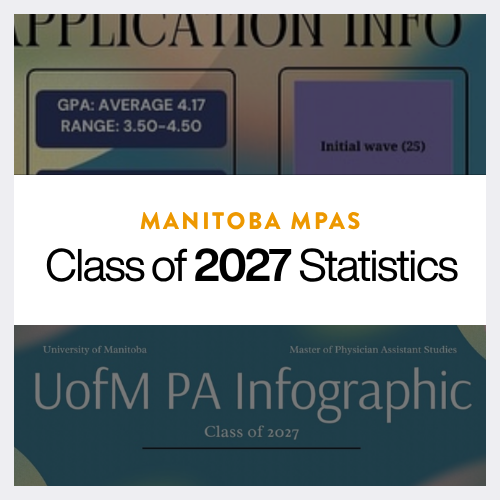
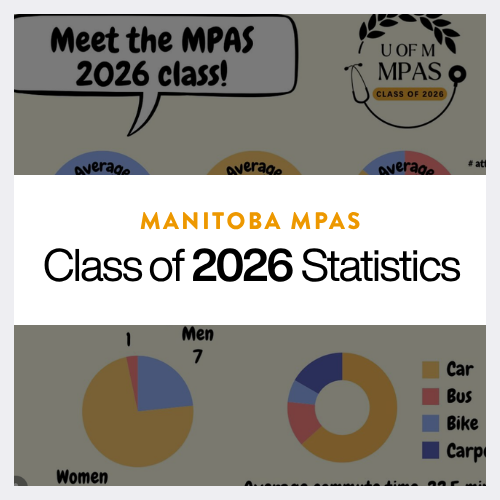
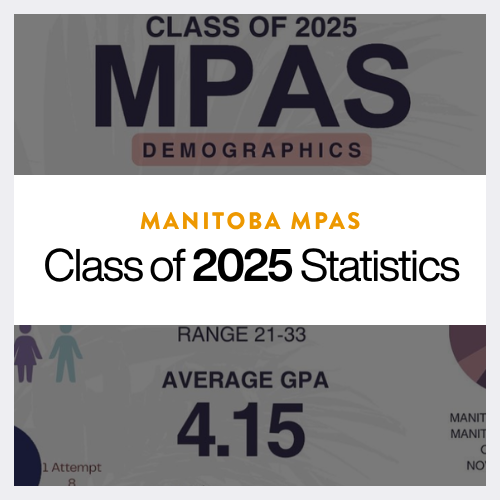
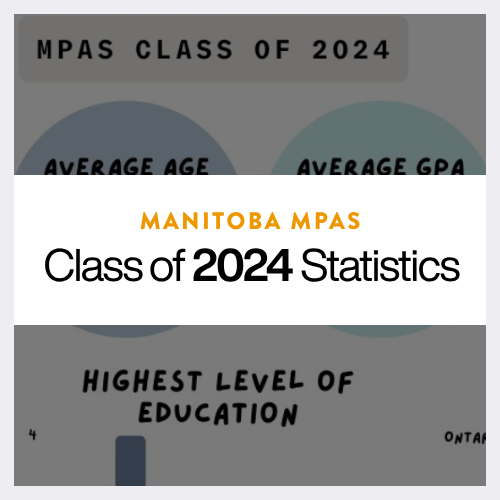
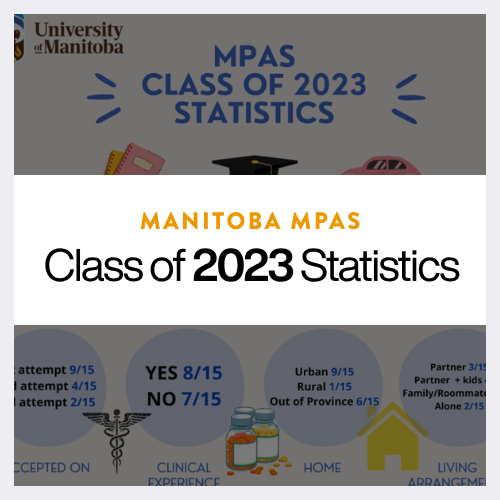
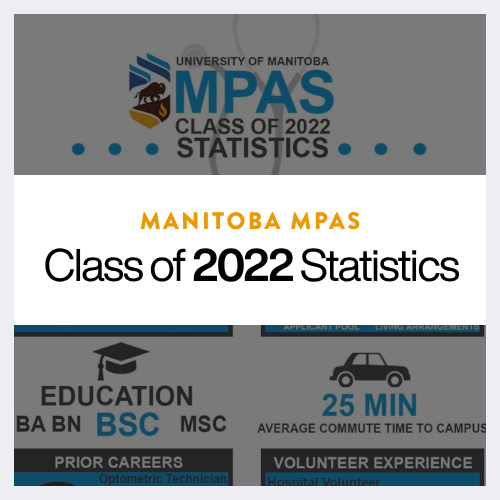
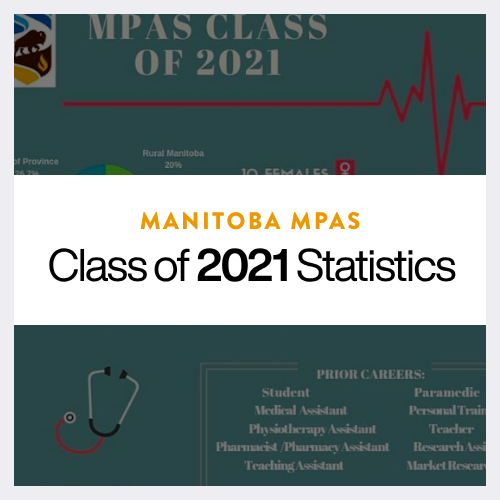
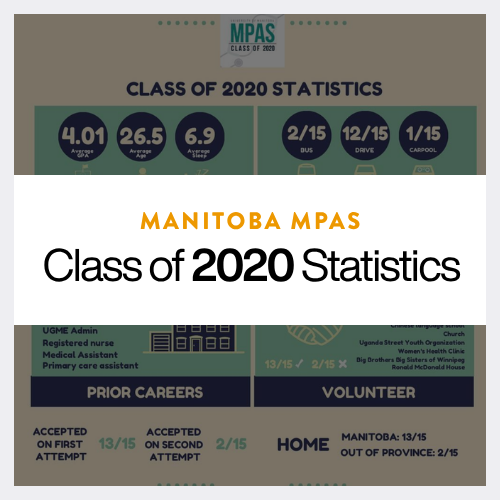
Manitoba MPASAccepted Student Infographics
Each year, the incoming class puts together a self-reported infographic. Inside they share Pre-PA Stats including GPA, academic background, interests, previous healthcare experience. Information is from the PA Student Association, not the PA program itself.