Episode #6: Claire, PA in Oncology
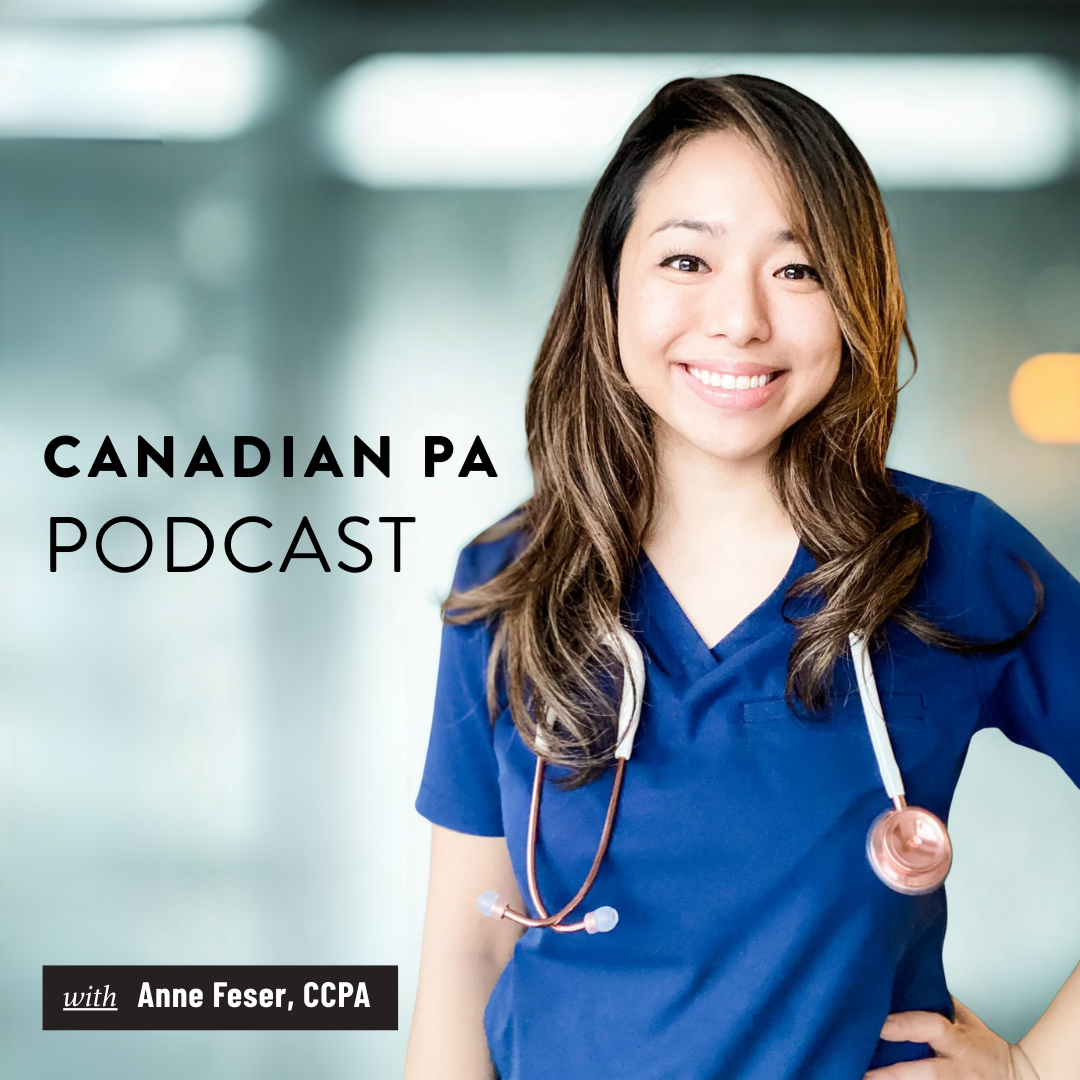
Claire shares her journey from a double major at UofT to becoming a trailblazing Physician Assistant in inpatient oncology at Sunnybrook. She discusses navigating complex goals of care conversations and managing oncologic emergencies like febrile neutropenia and spinal cord compressions.
Claire explains how she integrated a Master’s degree to launch research projects on existential distress and design reflective practice frameworks for PA students. Her experience illustrates how being vocal about niche interests can open doors to specialized roles and academic contributions.
WHAT YOU’LL LEARNHow to coordinate international 2nd year PA school electives like Johns Hopkins through networking
Clinical responsibilities and scope of practice of an oncology PA
How to effectively integrate a PA role into a multidisciplinary hospital team
GUEST BIOClaire is a McMaster PA graduate currently practicing as an Inpatient Oncology Hospitalist PA at Sunnybrook. She is a pioneer in her field, serving as a co-Principal Investigator on psychiatric research while balancing the high-acuity demands of a tertiary care cancer center.
Before entering the PA profession, Claire completed a double major in biology and psychology at the University of Toronto with a specific focus on disability studies. Driven by a desire for a flexible career that balanced medicine with her diverse personal interests, she transitioned directly into the PA program following her undergraduate studies.
During her time in the PA program, Claire became the first Canadian PA student to complete a month-long elective at Johns Hopkins in the United States. This experience, sparked by an early interest in oncology, allowed her to observe advanced PA roles before they were widely established in Canada. Since graduating, she has furthered her impact by pursuing a Master's degree to develop reflective practice and mentorship frameworks for future PAs

ON WHAT DREW HER TO ONCOLOGY“There's always something so authentic about being able to go through the hardest moments of life with someone and making it easier for them, but also learning really interesting medicine and interesting philosophies of life from patients. That's what drew me from the first day, and that's what's kept me going since then.”
— Claire, Oncology PA
ON PA VS. MD“With PA you get the best of both worlds. You can practice medicine, but you can also choose how much you get into it. You can switch specialties if you want. You can choose to work call or not, whatever your preference is.”
— Claire, Oncology PA
ON PIONEERING THE PA PROFESSION IN CANADA“Because it's such a new career in Canada, you could do anything with it. I didn't think that I would be designing a course, doing research about existential distress, but also treating cancer patients. That's a really cool evolution within the last five years of my career. You need to be open to being an advocate and being a trailblazer.”
— Claire, Oncology PA
ON USING REFLECTIVE PRACTICE AS A NEW PA GRAD“As come out of school, get right onto the job, and have to survive this steep learning curve. Because they're not doing residency, there's no structured learning after you graduate. To have reflective practice skills is to be able to identify your learning gaps such as why was a case so difficult, and figure out how you would approach it differently next time.”
— Claire, Oncology PA
ON THE IMPACT MENTORSHIP ON PA LEARNING"When you add the mentorship component, it almost brings the reflections to life and gives context to them. We end up having to make a transition in our identity — from being a patient, to being a student in healthcare, to being a healthcare professional. Having a mentor allows you to be more conscious of that process and reflect more purposefully on it."
ON GOALS OF CARE“You have to look at the whole picture and figure out how much of it is actually going to make a difference, not only in lifespan, but also quality of life. There are patients who might go through treatment and get so sick that it's not worth it to them if it means just an extra few days or an extra month. So it's all those really tough conversations and trying to figure out what's appropriate for a patient.”
— Claire, Oncology PA
ON PURSUING THE RIGHT SPECIALTY "FIT"“There were well-meaning people who suggested that no matter what, if anyone asks, say that you're interested in emergency because there are a lot of jobs there for PAs. So when a physician asked me what I wanted to do when I graduated, in my head I thought I should say emergency, but I said I want to be in oncology. And he said, 'Let me introduce you to some people.' If you feel passionate about something, just go for it.”
— Claire, Oncology PA
ON BURNOUT“I've definitely found myself feeling emotionally burnt out at times. But that's where you have to do a lot of self-care and really remember the moments where you've made a difference in someone's life. When you feel like you've made a horrible situation a little bit better for them, that's also quite rewarding.”
— Claire, Oncology PA
-
What is Oncology?
Oncology is the treatment cancer. It can be done as an outpatient, as an inpatient. PAs can be in any of the settings, it just depends on what the needs are of the environment. I work primarily as an inpatient oncology hospitalist PA.
I look after cancer patients admitted to hospital. Any complications from their cancer or from their treatment is what our service sees. We were doing haematologic oncology up until about 6 months ago. We would see new leukemic patients and do their induction treatments.
What is Goals of Care?
Goals of Care in Oncology is when when you are trying to articulate whats important to a patient: What are their values? Trying to match that with their treatment plan. Seeing what is available.
There are so many avenues that you can go down with Oncology. There are several lines of chemotherapy available, there is radiation and surgery might be possible. You also have to look at the whole picture. Not only in life span but also quality of life for patiens.
There are many patients who might go through treatment and get so sick that its not worth it to them to go through all of that if it means an extra few days or an extra month. Whereas for some patients, they might think that they want all the treatments possible even if there is a chance it actually makes life shorter for them. Its trying to figure out that balance and figuring out how far they want you to go. Would they want you to take them to ICU or do CPR? Its all of those tough conversations and trying to figure out what’s appropriate for a patient.
Common Conditions in Oncology
As an Oncology Hospitalist PA I manage some of the following common conditions:
Febrile Neutropenia
Hypercalcemia Malignancy
Sepsis
Bowel Obstructions
Hyponatremia
Related conditions secondary to immunotherapies patients going on (e.g. Colitis)
Neutropenic Enterocolitis
Spinal Cord Compression or Cauda Equina Syndrome
Rare Conditions I manage
Because we are a tertiary care centre we see a lot of :
neuroendocrine tumors
Paraneopalstic syndrome
refractory leukemias and lymphomas à This includes patients who go through multiple inductions and the complications.
Aplastic Anemia
Acute Promyelocytic Leukemia (APL)
Why I am drawn to Oncology
I think it’s the combination of interesting medicine and the human side to it. I really enjoy we see complex cases, sometimes you are seeing the sickest people in the hospital. At the same time you really get to know them.
I love getting to know people’s stories, I think there is always something so authentic about going through the hardest moments of life with someone and making it easier for them. But also learning some really interesting medicine and interesting philosophies of life from patients. That is what drew me from the first day that I did that shadowing opportunity in first year of PA school, that is what kept me going since then.
What to Expect from an Oncology Hospitalist PA
There is nothing too different to expect from seeing a PA versus seeing one of the hospitalists. Because the way our program works we have several hospitalists who see the patients and there’s me as well. I am seeing the patients that my supervising physician would have been seeing, but he is also doing administrative work because he is the most responsible physician for the whole service.
If a patient is seeing me, they would expect:
daily medical visits from me
any diagnosis
treatment and management plans
initiating/continuing medications and discharge medications
procedures (e.g. lumbar punctures, paracentesis, thoracentesis, bone marrow biopsies).
We would discuss goals of care.
We would talk about any discharge planning.
Family Meetings – If it involves one of my patients, then I am running the meeting, or the social worker and I acting as a close right hand provider for medical updates.
All the things they would expect to see from a doctor on the team, they could also receive that from me.
Breaking Bad News
Breaking bad news is not always at the later stages. If there is progression of disease, or there is a new diagnosis, that is a difficult scenario. Or if they lose function of their legs, they could live for another year, but if it means they’re not walking that’s may also be devastating for someone. I’ve definitely had to break bad news and I think that was one of the most overwhelming things during the first year of practice. I thought to myself, “I’m 23 years old, and I’ve been breaking a lot of bad news, and its very difficult”. One of the palliative care physicians I met actually actually said that her job makes her feel like she appreciates life even more. When you look at it from that perspective sometimes it’s a job keeps you grounded.
Day in the Life of an Oncology Hospitalist PA
Usually we start at 9 o’clock. I come and meet with the rest of the hospitalists and my supervising physician. He divides up the patients amongst us. Typically the hospitalist will see patients and I will see 8 patients per day.
We each go in for bullet rounds where we discuss our plans for our patients with the rest of the allied health team and team leader. Throughout the day, I am seeing patients in order of acuity. Whoever is least stable gets seen first.
I try to save any family meetings or procedures for the afternoon. I also started a research project in hospital. I am co-principal investigator within our own ward. I work with the research assistants and guide them along the process as well.
My schedule My job is 9 to 5. There could be option to do call. Typically we do have residents doing call.
Impact of a PA on the Oncology Service
My supervising physician is able to dedicate more time to administrative work. Typically he would have split his time between seeing patients, overseeing the whole service and having go back and do the administrative work.
He has been able to assign his patient load to me while he attends to everything else. This has really helped our group function smoothly. Our group has been able to evolve because of that.
Challenges of working in Oncology
There is a higher likelihood of burnout. I have found myself finding emotionally burnt out at times. That is where the you have to do a lot of self care and also really remember the moments you’ve made a difference in someone’s life.
It gets difficult if you feel attached to a patient or you meet someone who is young, just started their life and they are diagnosed with a very serious illness. Those can be difficult. I also feel that when you feel you’ve made a difference in their life, and you’ve made this horrible situation a little bit better for them, it’s also quite rewarding.
Who would do well in Oncology?
Someone who is optimistic, who is also very introspective and knows how to reflective. Those are the types of people that would do well with Oncology.
Also having a good sense of humor helps as well. Its interesting because even patients will have a really good sense of humor about things. Sometimes you think you are coming in and you’re feeling glum, but the patient will crack a joke that you may think is inappropriate for their situation – but that’s how you get through things.
If you can have a good a balance of being resilient, having a sense of humor, but also be introspective and be a sensitive person I think that’s a good fit for oncology.
Beyond Clinical PA Practice
Furthering My Education
Because I have a lot of interests, and I also had a desire to teach. The first thing that motivated me was teaching, but also I wanted to learn more about the health care system. This Master’s of Community Health is based off of the Public Health School, and the Family and Community Medicine Department at University of Toronto.
I learned a lot about public health as well, that uncovered another interest for me. I wanted to learn more about research in order to things like the research project I am doing now.
I did not have a lot of background in research in my undergraduate degree. When I found a topic that I was really interested in the past couple of years, I knew that I needed more skills to do something about it. The Master’s Degree helped with that.
Public Health is looking at the social determinants of health. Looking at how poverty affects health outcomes of a person, how food insecurity affects people’s health outcomes, even how political instability can affect people’s health outcomes. The migrant crisis and refuges – its something that going to continue to progress in the next few years and just looking of undocumented people in our own city. Those are things I want to learn more about and take more of an activist role on in the near future.
Project 1: My Master’s Project on Teaching
The first is more of a teaching based project. I just complete Practicum or Capstone project where I design the framework for a course that I plan to propose in a PA program. It is about reflective practice and mentorship. PA, and really all health care professionals will need to be efficient, self-directed learning in order to flourish and continue to grow as professionals. For PAs in particular it is really important because PAs come out of school, get right onto the job and try to secure employment but also survive a steep learning curve. And you know because they are not doing residency there is no structured learning after you graduate.
To have reflective practice skills to be able to identify what are your learning gaps? Why was a case so difficult? And be able to go back and think about it later on. Figure out how you would approach a case differently next time. In order for PAs to grow, its important to have reflective practice listening. I saw a study that showed if PAs did not have as much self-directed learning skills, if they weren’t supportive a work environment there is a risk of leaving the career because they have trouble coping. I did design a framework that introduces reflective practice but in an interactive way that is attractive to students, and its been found to work in other programs. My hope is to start getting this developed or rolled out in the next few years.
I include the mentorship/interactive piece because I find that reflective practice alone is not attractive to students. There is systematic review that shows even just thinking about myself and interviewing others students, when you are trying to learn other things including medicine, clinical skills, then learning how to do reflections on the side becomes very difficult. When you add the mentorship component, it also brings the reflections to life. It gives context to it. You end up developing a relationship with a practicing PA and you are able to bounce your ideas off of them, and they can teach you where reflection comes into play.
We end up having to make a transition from our identify from being a patient, to being a student in health care, to then, being a health care professional. Having a mentor allows you to be more conscience of that process, and reflect more purposefully on that.
Project 2: Research-Based Project
This is the one where I am currently a co-Principal Investigator. I am working with one of the psychiatrists in our unit. We are looking at meaning centered Psychotherapy and Existential Distress. Right now it’s the early stages, we are trying to explore the prevalence of Existential Distress in Oncology patients, and to see if it has any effects on health care outcomes, their own outcomes, hospital use, length of stay, quality of life for them. If we do have findings on this, perhaps we can take Meaning Centered Psychotherapy into the hospital, because at this time it is in clinics supporting more of the well patients.
Existential Distress is a loss of meaning in life. People can go through depression, anxiety, but existential distress is when you are typically suffering and you are not seeing meaning in the suffering. You have lost all meaning in life. That is what we are trying to explore in patients at this time.
Final Notes
Tips if you’re thinking about becoming a PA
If there weren’t any other considerations in life, I would say go for it.
I think its really flexible career, I think the possibilities are endless. I think that you get to practice, you are well compensated, but I also think that because its such a new career, at least in Canada that you could do anything with it. And I think that’s what fascinating.
I didn’t think I would be designing a course or doing research about Existential Distress while also treating cancer patients. I think its really unique evolution within the last 5 years of my career. I also think that its important that if you are considering it, you need to open to being advocate and being a trail blazer. There are a lot of challenges to that, but there are also rewarding things.
Tips if you are a current PA student
I also think if you are a PA student and you know the field you are interested in, be vocal about it.
When I was in clerkship, I think that there were well meaning people that suggested to me – ‘no matter what if anyone asks you say that you’re interested in Emergency Medicine, for example, because there are a lot of jobs there for PAs, and you need a job when you graduate’.
So when I was an Emerg, a physician asked me ‘What do you want to do when you graduate’? In my head I said, “I should say Emergency Medicine” but I decided to come out and say, “I want to do Oncology, I know it probably sounds strange and it sounds like there are no work for PAs there.” And The Emergency Physician said he would introduce me to some people, and he introduced me to the Oncologist who is now my supervising Physician.
I think that if you feel passionate about something, just go for it.
-
Why Claire Chose the Physician Assistant Path
Claire [0:00] I had a general sense that I wanted to go into medicine in one form or another. My uncle and my aunt both recommended the PA program. I had a general sense of what it was. I think part of me was just saying yes to many things that year.
Claire [0:17] But once I was in the interviews, I realized how much I wanted to be a part of the program.
Anne [0:23] And that was the EPA interviews, yes. So what were some of the things that your uncle and your aunt — was she the nurse practitioner? — what were they saying about the profession that made them want to recommend it to you?
Claire [0:35] I think quality of life was the biggest thing. My aunt coming from the advanced practice side and my uncle coming from the physician side, both recognized that with PA you kind of get the best of both worlds.
Claire [0:52] You can practice medicine, but you can also choose how much you get into it. You can switch specialties if you want. You can choose to work call or not — whatever your preference is.
Claire [1:08] They know I'm the type of person who has many different interests within and outside of medicine. So for me to be able to do something that allows me to maintain all my other passions was a big deal.
Claire [1:24] Their other point was that you literally have two years of schooling after your undergrad, and if you don't like it, you can move on to something else. Or if you still want to do more schooling, you can.
Claire [1:41] It's not like you're investing a decade of your life into it.
Anne [1:45] What was your background in undergraduate study before pursuing PA?
Claire [1:50] I did a biopsych double major at U of T. It's actually called Exceptionality in Human Learning — a combination of disability studies and biology. Then I went straight to the PA program afterwards.
Anne [2:06] Were you considering other programs at that time?
Claire [2:08] Yeah, I had thought about behavioural therapy, and I definitely thought about going into an MD program.
From PA School to Oncology: A Trailblazing Path
Anne [2:16] So how was your experience going through the program?
Claire [2:18] It was great. I actually think out of the six years of school I had done, those were my favourite. In my first year, during the longitudinal clinical experiences, I met an oncologist and the way she introduced oncology to me was what hooked me.
Claire [2:41] I kept in touch with her since then. Throughout clerkship, I tried to do as much oncology as I could. I did it at Sunnybrook and also went to Johns Hopkins for a month-long elective.
Anne [2:57] That's in the United States, yeah. Wow. And even within your surgical rotation, you get to choose a selective?
Claire [3:09] Yes, I asked to be placed in surgical oncology for at least two weeks.
Anne [3:14] So throughout that you were exposed to different facets of oncology from different perspectives. How did you go about setting up the rotation at Johns Hopkins in the United States?
Claire [3:20] It was actually through the oncologist I met in first year. I went back for more experiences with her — completely optional — and she was affiliated with Johns Hopkins. I told her how much I loved oncology, and she not only set me up with a rotation there, but also with a PA there.
Claire [3:39] So I got to see what PAs were doing in oncology before they really even existed here in Canada. I was actually the first Canadian PA to come there, which was a really cool experience for them too.
Anne [3:55] And I think there are about 14 or 15 oncology PAs in Ontario.
Claire [3:59] Yeah, I think so.
Anne [4:01] That's really neat — you're definitely a trailblazer in that regard. Did you need any special visas to set that up to be in the States for however many weeks?
Claire [4:11] Four weeks. I think all I needed was a letter — one from Johns Hopkins acknowledging I was coming and one from my school confirming it was an elective. I just showed that at the border.
Anne [4:25] That's great. I was curious about that because I know some students do international electives, but I haven't known anyone to go down to the States to do it. What was your experience like when you were hired on for the oncology service?
Claire's Transition to an Inpatient Oncology PA
Claire [4:40] I think it was actually a pretty good transition because my last rotation before graduating was there. By that time, they already knew they wanted to hire me, so coming back was like returning to people I already knew.
Claire [4:56] It was really just a transition in title — from student to someone whose orders are valid.
Anne [5:03] How were you oriented to the service, and how did they know how to use you?
Claire [5:08] A lot of it came through my rotation. When I first met people on the team, I would explain what a physician assistant was. My supervising physician was very open to it — right away he was comfortable delegating things to me and figuring out together what I was comfortable with and what he was comfortable letting me do.
Claire [5:32] Once I started working at Sunnybrook, I put together a short PowerPoint and presented it to the nursing team and in clinic — even though I don't work in the clinics — just so the oncologists could become familiar with me.
Claire [5:49] It certainly helped that they had already experienced me as a student. I spent a few weeks going to different oncology clinics — even though I haven't returned to clinic since — just to see each tumour site's typical treatments, the kinds of cases they see, and to get to know the physicians.
Anne [6:15] And for those without a medical background, what is oncology?
Claire [6:20] Oncology is the treatment of cancer. It can be done as an outpatient or as an inpatient, and physician assistants can work in either setting — it depends on the needs of the environment.
Claire [6:36] I work primarily as an inpatient oncology hospitalist PA, which is a mouthful — but it basically means I look after cancer patients who are admitted to hospital, whether it's complications from their cancer, from their treatment, or anything our service sees.
Claire [6:59] We were also doing haematologic oncology up until about six months ago, so we would even see new leukemia patients come in and go through their induction treatments.
Navigating Complex Decisions and Human Connection in Oncology
Anne [7:11] You mentioned goals of care — can you explain what that means?
Claire [7:15] Goals of care is the process of figuring out what's important to a patient — their values — and trying to match that with their treatment plan while also looking at what's actually available to them.
Claire [7:36] There are so many avenues in oncology: several lines of chemotherapy, radiation, surgery that might be possible. But you also have to look at the whole picture and figure out how much of it will actually make a difference — not just in lifespan, but in quality of life.
Claire [8:01] Some patients might go through treatment and get so sick that it's not worth it to them if it only means an extra few days or a month. Others might want every possible treatment, even if there's a chance it could shorten their life. You're trying to find that balance with them — and figuring out how far they'd want you to go if they're deteriorating. Would they want ICU? CPR?
Claire [8:44] Those are really tough conversations — trying to figure out what's appropriate for each patient.
Anne [8:51] What's always drawn you to oncology specifically?
Claire [8:56] It's the combination of really interesting medicine and a deeply human side to it. I love that we see really complex cases — sometimes the sickest people in the hospital — but at the same time you really get to know them.
Claire [9:16] I love getting to know people's stories. There's something so authentic about going through the hardest moments of life with someone and making it a little easier, while also learning fascinating medicine and equally fascinating philosophies of life from patients.
Claire [9:41] That's what drew me in from the very first shadowing experience in first year of PA school, and that's what's kept me going since.
Managing Conditions and Patient Interactions as an Oncology PA
Anne [9:54] What are some common conditions you come across in oncology?
Claire [9:54] We see a lot of febrile neutropenia, hypercalcemia of malignancy, sepsis, bowel obstructions, and hypernatremia. We also see a lot of immune-related conditions secondary to immunotherapies — colitis is very common, as well as neutropenic enterocolitis and spinal cord compressions, including cauda equina syndrome. Those are kind of our bread and butter.
Anne [10:23] And are you managing all of these conditions as they come up in hospital?
Claire [10:28] Yes.
Anne [10:29] What are some of the rarer conditions you come across from time to time?
Claire [10:33] Because we're a tertiary care centre, we see a lot of neuroendocrine tumours, paraneoplastic syndromes, and more refractory leukemias and lymphomas — patients going through multiple inductions where the complications become very intense. We also see aplastic anemia and APL.
Anne [10:59] If a patient were to see you on the ward, what would they expect working with a PA?
Claire [11:08] I don't think there's much difference for them compared to seeing one of the hospitalists. The way our program works is that several hospitalists see patients, and I'm one of them. I'm seeing the patients my supervising physician would have seen, while he manages administrative responsibilities as the most responsible physician for the whole service.
Claire [11:25] If a patient is seeing me, they'd get daily medical visits, any diagnosis and treatment decisions, and procedures — lumbar punctures, paracentesis, thoracentesis, bone marrow biopsies. We'd discuss goals of care and discharge planning. Everything they'd expect from a physician on the team, they can also receive from me.
Anne [12:15] Are you involved in family meetings?
Claire [12:16] Yes. If it's one of my patients — I see about eight a day — I'm usually either running the meeting or the social worker is running it and I'm acting as the close right hand, providing all the medical updates.
Claire's Typical Day and PA Impact on the Department
Anne [12:33] Can you walk us through a typical day at the hospital?
Claire [12:39] There's no rigid structure. We usually start at 9:00. I come in, meet with the hospitalists and my supervising physician, and he divides up the patients among us. Typically the hospitalists will see 12 patients and I'll see eight.
Claire [12:55] After that, we each go to bullet rounds, where we discuss plans for our patients with the allied health team and the team leader. Then throughout the day I see patients in order of acuity — least stable gets seen first. I try to save family meetings and procedures for the afternoon.
Claire [13:12] More recently I've also started a research project in hospital — I'm co-principal investigator for a project on our ward. So in the afternoons I work with the research assistants and help guide them through the process.
Anne [13:41] Is your schedule typically 9 to 5, or do you do evenings, weekends, or call?
Claire [13:46] It's 9 to 5. There could be an option to do call, but because we have residents covering it, I've been able to avoid that, which is nice.
Anne [14:00] What differences has the department noticed since adding a PA to the oncology team?
Claire [14:05] The biggest difference is that my supervising physician can now dedicate more time to administrative work. Previously he had to split his time between seeing patients, overseeing the whole service, and going back to do administrative work. Now he can assign his patient load to me while he attends to everything else. Our group has been able to function more smoothly and really evolve because of that.
Overcoming Burnout and Breaking Bad News in Oncology
Anne [14:40] What do you find challenging about working in oncology?
Claire [14:44] There's a higher likelihood of burnout. I've definitely felt emotionally burnt out at times. That's where you really have to focus on self-care and remind yourself of the moments where you've made a difference in someone's life.
Claire [15:06] It gets difficult when you feel attached to a patient, or when you meet someone young who's just started their life and has been diagnosed with a very serious illness. Those cases are hard. But when you feel like you've made a difference — made a horrible situation even a little bit better for them — that's also deeply rewarding.
Anne [15:38] Are you in situations where you're breaking bad news, or are you mainly working with patients in the later stages?
Claire [15:46] It's really a variety. Bad news doesn't just come at the later stages. Sometimes it's disease progression, a new diagnosis, or even losing function — like if someone loses the use of their legs but could still live another year. That can be just as devastating.
Claire [16:17] I've definitely had to break bad news. During the first year of practice it was overwhelming. I remember thinking — I'm 23 years old and I'm breaking a lot of bad news. It's very difficult. But one of the palliative care physicians I met said that her job makes her appreciate life even more. When you look at it from that perspective, it's a role that really keeps you grounded.
Anne [17:00] Absolutely. So what kind of PA or person would do well in oncology?
Claire [17:06] Someone who's optimistic and very introspective — someone who knows how to reflect. Those are the people who would do well. But also someone with a good sense of humour. Even patients will have a great sense of humour about things. You might come in feeling a bit glum, and the patient cracks a joke that you'd almost think is inappropriate for their situation — but that's how people get through things.
Claire [17:52] So if you can balance being resilient and having a sense of humour with being introspective and sensitive, that's a good fit for oncology.
Advancing Education: Master's Degree and Public Health Interests
Anne [18:07] When new PA grads first come out of school, the first goal is usually to establish themselves in clinical practice. You've also been pursuing your master's, which you just finished. What made you decide to further your education?
Claire [18:25] I have a lot of interests, and I also wanted to teach. Teaching was the first motivator, but I also just wanted to learn more about the healthcare system. This master's is based in the public health school and the Family and Community Medicine department at U of T, so I learned a lot about public health as well — and that uncovered another interest for me.
Claire [18:48] I also wanted to build more research skills so I could take on the kind of project I'm doing now.
Anne [19:04] Did you have much research background in your undergraduate?
Claire [19:08] I didn't. I took one research opportunity program in undergrad and honestly don't remember much about it. It was only when I found a topic I was really passionate about over the past couple of years that I knew I needed more skills to actually do something about it. The master's degree really helped with that.
Anne [19:34] What do you mean by public health?
Claire [19:35] Looking at social determinants of health — how poverty affects health outcomes, how food insecurity affects people, how political instability can affect health. The migrant crisis and refugees are issues that will continue to grow in the coming years, and I'm also interested in the health of undocumented people within our own city.
Claire [19:54] Those are areas where I want to learn more and take a more activist role in the near future.
Designing Reflective Practice and Exploring Existential Distress
Anne [20:19] Can you speak to what your master's project was about?
Claire [20:22] There are two projects. The first is more of a teaching-based project. I designed the framework for a course that I plan to propose in a PA program, centered on reflective practice and mentorship.
Claire [20:47] Physician assistants — really all healthcare professionals — need to be efficient self-directed learners to grow as professionals. For PAs in particular, it's especially important because we come out of school, have to secure employment, and immediately face a steep learning curve. There's no structured residency after graduation.
Claire [21:05] Reflective practice means being able to identify your learning gaps — asking why a case was difficult, going back to think about it, and figuring out how you'd approach it differently next time. A study I came across showed that PAs without strong self-directed learning skills, if they're also in an unsupportive work environment, are at risk of leaving the career because they struggle to cope.
Claire [21:43] So I designed a framework that introduces reflective practice in an interactive way that's actually attractive to students — it's been shown to work in other programs. My hope is to get it developed and roll it out in the next few years.
Anne [22:27] Can you speak to the interactive component specifically?
Claire [22:30] The mentorship component. Reflective practice on its own isn't very attractive or relatable to students — there's actually a systematic review that shows this. Even thinking about it myself and interviewing other students: when you're already learning medicine and clinical skills, adding reflections on the side becomes very difficult.
Claire [22:57] But when you add the mentorship component, it almost brings the reflections to life and gives context to them. You develop a relationship with a practicing PA, you bounce ideas off them, and they can show you where reflection actually applies. We all go through a transition in identity — from patient, to student, to healthcare professional — and having a mentor makes you more conscious of that process and helps you reflect more purposefully on it.
Anne [23:43] And the second project?
Claire [23:45] The second is a research project. I'm currently co-PI for a project on our ward. I'm working with one of the psychiatrists in our unit, and we're looking at meaning-centred psychotherapy and existential distress.
Claire [24:03] Right now we're in the early stages, exploring the prevalence of existential distress in oncology inpatients and whether it affects healthcare outcomes — their own outcomes, hospital use, length of stay, quality of life.
Claire [24:24] If we find significant results, the next step would be bringing meaning-centred psychotherapy into the hospital setting, since right now it's mainly offered in outpatient clinics supporting more stable patients.
Anne [24:37] Can you clarify what you mean by existential distress?
Claire [24:42] Existential distress is essentially a loss of meaning in life. People can experience depression or anxiety, but existential distress is different — it's when you're suffering and you can't find meaning in that suffering, or you've lost all sense of meaning entirely. That's what we're trying to explore in inpatients.
Be an Advocate: Advice for Future Physician Assistants
Anne [25:06] What's your recommendation for anyone interested in pursuing the PA profession?
Claire [25:12] If there were no other considerations in life, I'd say go for it. It's a really flexible career with endless possibilities. You get to practice medicine and you're well compensated.
Claire [25:36] But because it's such a new career, especially in Canada, you can do almost anything with it. I didn't imagine I'd be designing a course, doing research on existential distress, and also treating cancer patients. That's a pretty remarkable evolution within five years of a career.
Claire [25:58] That said, I think it's important that if you're considering it, you need to be open to being an advocate and being a trailblazer. There are real challenges to that, but also a lot of deeply rewarding things.
Claire [26:19] If you're a PA student and you know the field you're interested in, be vocal about it. When I was in clerkship, some well-meaning people told me that no matter what, if anyone asked, I should say I wanted to do emergency because there are a lot of PA jobs there and I needed employment when I graduated.
Claire [27:00] So when I was in emergency, a physician asked what I wanted to do when I graduated. In my head I thought I should say emergency — but instead I just came out with it. I said I wanted to be in oncology. I knew it probably sounded unusual, like there was no market for PAs there.
Claire [27:22] And he said, "Let me introduce you to some people." He introduced me to my supervising physician. If you feel passionate about something, just go for it.
Anne [27:36] Thanks so much for watching. If you have any further questions for Claire or for me, please leave a comment below — I respond to every one. Don't forget to like and subscribe for updates.