Episode #20: Stephanie Ruttinger, PA in OB/GYN
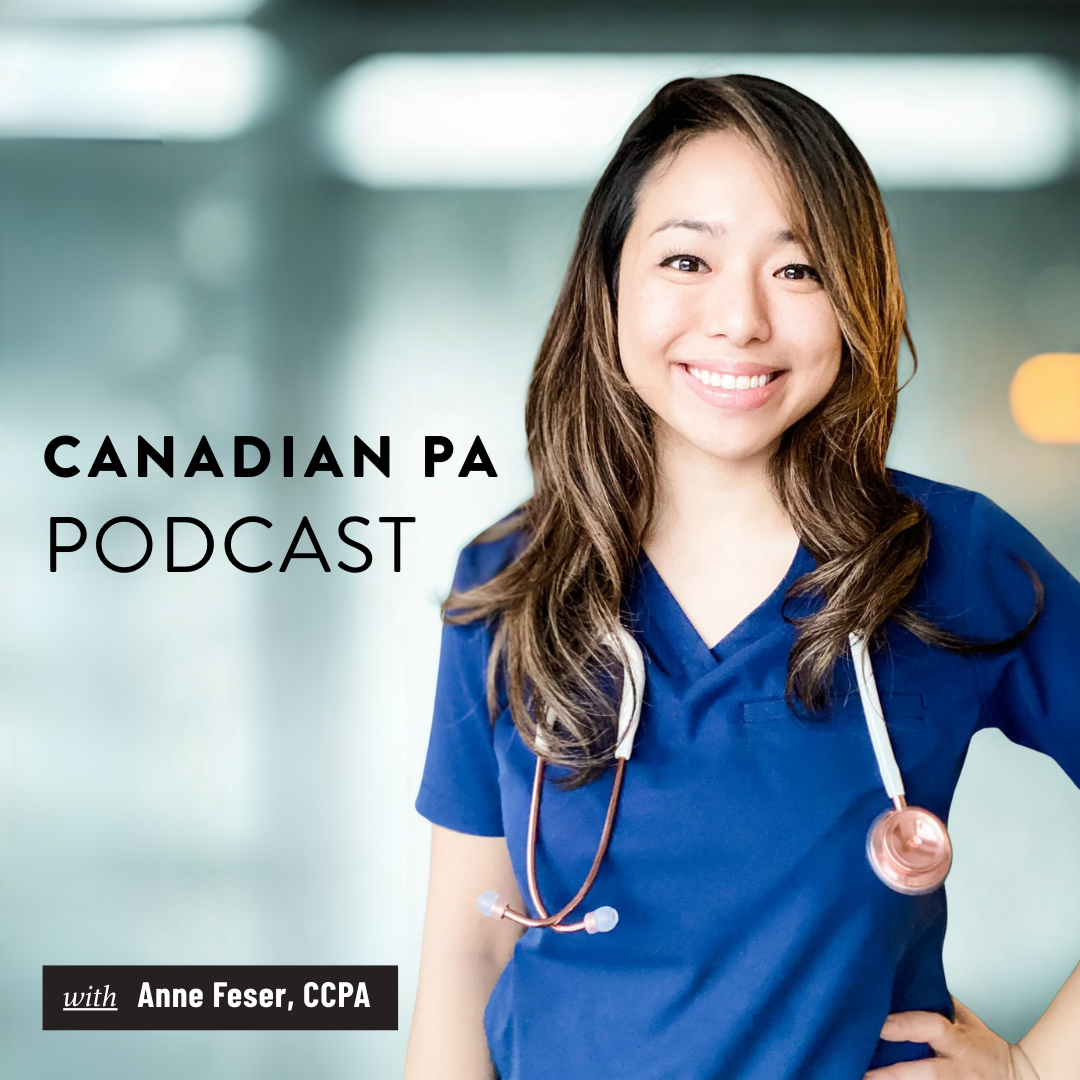
“Pregnancy is a big black box for a lot of care providers. If someone comes in with a medical disorder and happens to be pregnant, that’s an area of discomfort for a lot of adult or pediatric care providers. That’s really where maternal fetal medicine comes in, we bridge the gap between the medicine and the pregnancy.”
Stephanie is a McMaster-trained PA who graduated in 2015 and landed her dream job in maternal fetal medicine (MFM) at McMaster University Medical Centre. Four years later, she's still there seeing high-risk pregnancies, first-assisting on cesarean sections, and teaching PBL tutorials at the very program that trained her.
She explored other professions like genetic counselling, physiotherapy, occupational therapy, and even applied to an accelerated nursing program before stumbling across the PA profession online one night. What she found in the McMaster PA program was a self-directed learning model that immediately clicked, and a four-week MFM elective that quietly became a job interview.
Stephanie shares what work as a subspecialty PA practice looks like in Canada. She discusses the clinical depth of MFM and the emotional weight of working with patients facing the hardest moments of a pregnancy.
WHAT YOU’LL LEARNHow to use elective rotations strategically as a “working interview“
What the day-to-day PA role looks like in a tertiary maternal fetal medicine service from triage to the operating room
How to build credibility in a specialty where almost no one knows what a PA is
What to expect when PA autonomy shifts in a high-acuity subspecialty setting
GUEST BIOStephanie Ruttinger is a graduate of the McMaster University PA Program Class of 2015 and currently practices in maternal fetal medicine at Hamilton Health Sciences.
She completed a degree in Physiology at Western University, with early exposure to obstetrics through shadowing and research in intrauterine growth restriction. She discovered the PA profession late in her training and found McMaster’s problem-based learning model aligned well with her strong science background and preference for self-directed learning.
Following graduation, she accepted a position in maternal fetal medicine at McMaster University Medical Centre, where she had completed an elective. She manages outpatient consults and inpatient care, assists in cesarean sections, and supports patient education within a high-risk obstetrics service. She also contributes to the PA program as a reproductive system PBL tutor.

ON IF PAs CAN WORK IN OB/GYN - MATERNAL FETAL MEDICINE“There aren’t many PAs in this area, so there are still a lot of questions about what a PA can and cannot do here. Can a PA be useful in maternal fetal medicine? The answer is yes. I’ve been there four years. I know I’ve brought a lot to the table. Be creative about how you get in because I’ve seen firsthand that it works.”
— Stephanie Ruttinger, PA in OB/GYN/MFM
ON CHOOSING PA OVER MD
“The MD route was something I was really interested in, and I'm very, very happy I chose PA for a couple of reasons. Lifestyle is a big deal. I know I don't do well without sleep-I learned that the hard way in clerkship. And the fact that I don’t have to do call shifts as a PA genuinely impacts my mental health. That matters”
— Stephanie Ruttinger, PA in OB/GYN/MFM
ON PATIENT EDUCATION“What I can do is spend a lot more time on patient education on the things that might not be the main chief complaint but matter enormously. When someone comes in for the first time, maybe it’s their first pregnancy, there are a lot of questions, a lot of education that needs to happen. Being able to sit down and focus on that. I think that's where I make a real difference.”
— Stephanie Ruttinger, PA in OB/GYN/MFM
ON BUILDING RAPPORT WITH PATIENTS “When someone isn't sure what a PA is or what we can do, telling them your credentials only gets you so far. Sitting down with a patient, getting a good rapport with them, showing them you have the knowledge and the skill set to treat them — that's how you earn their trust. Actions speak louder than any explanation”
— Stephanie Ruttinger, PA in OB/GYN/MFM
ON CLERKSHIP“Clerkship was an eye-opening experience. I always tell people in the PA program now that you're going to learn at such an accelerated rate during clerkship compared to studying on your own. The amount you retain when you're learning around a real patient rather than a case in a textbook is significant”
— Stephanie Ruttinger, PA in OB/GYN/MFM
ON THE EMOTIONAL WEIGHT OF WORKING IN HIGH RISK OBSTETRICS“Sometimes it's not the happiest area. People get diagnosed with cancer at one of the most difficult times in their lives. Sometimes there's very bad news about a pregnancy or even a stillborn baby. You have to try not to take that home. But you step back and remind yourself how much good you're doing for this population, and the good absolutely outweighs the hard. That's what keeps you going.”
— Stephanie Ruttinger, PA in OB/GYN/MFM
-
From Windsor to MFM: Stephanie's Path to Becoming a PA
Anne [0:23] Stephanie, can you tell us a little bit about yourself?
Stephanie [0:27] So I'm originally from Windsor. I went to the McMaster PA program and graduated in 2015. I fell in love with Hamilton when I was there — I really liked the outdoor feel of it, but it's still a big city, so I wanted to stay.
Stephanie [0:43] It just so happened that when I graduated, there was a great job opportunity that was actually my dream job in maternal fetal medicine. So I took that job and it ended up working out really well. I've been in Hamilton in maternal fetal medicine for pretty much four years exactly — maybe two weeks from now is my four-year anniversary.
Anne [1:11] Tell us a little bit about what you were doing before you started your PA journey.
Stephanie [1:15] Before I started my PA journey, I did my undergrad at Western University in Physiology, with a lot of pharmacology courses as well. I knew I was interested in the medical world from early on.
Stephanie [1:32] While I was in undergrad, I had a great opportunity to shadow some physicians, including some obstetricians and gynecologists. I was also able to do some research in intrauterine growth restriction and got a publication out of that. So I think I was well equipped going into the PA program with all of that background.
Exploring Healthcare Careers and Finding the PA Program
Anne [2:08] And were you contemplating other careers at the time?
Stephanie [2:11] In healthcare, yeah, for sure. I looked through everything. I looked at the MD route and realized that was a long, hard road, and even after you start working, the hours are long. From a lifestyle perspective, I considered it, but I wanted to look at other options too. Anything from genetic counsellor, physiotherapist, occupational therapist — I even thought about nurse practitioner.
Stephanie [2:48] I had applied to the accelerated nursing program in London, but decided to stick with my Physiology degree instead. Then one night, looking through the internet trying to figure out what would be a good fit for me, I kind of stumbled on the idea of the physician assistant program. It was actually in the context of US programs that I first came across it, and then I did a bit more research and realized there was a Canadian program. It was something I found entirely on my own.
Anne [3:25] You applied and got into the PA program — and how did you enjoy PA school?
Stephanie [3:31] I loved it. I was a little nervous about the self-directed learning aspect because my undergrad was very didactic and I had no experience with problem-based learning. I wasn't quite sure what to expect, but I actually realized it worked really well for me. Having a good foundation in the medical sciences helped a lot, and being able to schedule my studying around my personality and lifestyle made a big difference.
Longitudinal Placements and Learning Through Observation
Anne [4:07] The program at Mac in first year has students do longitudinal placements — half-day observerships. Where did you end up doing some of yours?
Stephanie [4:16] My first LP was actually with a fellow PA, Denise O'Leary, in the family clinic she was at. It was early on — I think we had just learned about the respiratory and cardiac systems — so going in and seeing how a PA functions was a big deal. I was able to get some of my first real hands-on experience with patients, even just taking short histories or practising my examination skills. It made a big difference early on.
Stephanie [4:53] From there I did a ride-out with EMS, which was an interesting experience just to see what happens before people come into hospital. My third LP was with obstetrics and gynecology, specifically in the fertility side of things, which was really cool to see.
Hands-On Training: Clerkship, Electives, and Job Search
Anne [5:16] In second year, PA school consists of core and elective rotations. How did you enjoy clerkship?
Stephanie [5:24] Clerkship was an eye-opening experience. I always tell people in the PA program now that you're going to learn at such an accelerated rate during clerkship compared to studying on your own. The amount you retain when you're learning around a real patient rather than a case in a textbook is significant — at least for me, from a memory standpoint.
Stephanie [5:49] I did most of my rotations in the Hamilton area because I knew I liked it there and I wanted to be in an academic centre. It was challenging at first — the hours were different than I was used to, and keeping up with studying on top of the clinical work was a bit of a stretch. But overall, it was a great experience to get that hands-on learning.
Anne [6:20] And where did you end up doing your elective rotations?
Stephanie [6:21] I did quite a few elective rotations because I split them up a bit. I did four weeks in maternal fetal medicine — the actual job I have now — and it was a great way to get an introduction to an area I was very interested in. It almost acted like a preliminary job interview. My bosses got to know me as a student, saw different aspects of how I worked with the team, and that ultimately led to a job. So that was a really good experience.
Stephanie [7:05] I also did a lot of the internal medicine subspecialties — some endocrinology and some cardiology — just to get more exposure. And I did a neurosurgery elective, mostly because it was an area I didn't feel was my strong suit.
Anne [7:27] And did you have any idea where you were going to end up working during school?
Stephanie [7:31] It was a big unknown at first, as I think it is for all PA students. There's a little stress with that. But I was hopeful about the new career start grant that came out and wanted to wait and see what job opportunities came up. I was also willing to move for the right job, so I wasn't overly stressed about staying in one specific city. I kept an eye out for openings even before school ended, just in case something came up early.
Inside Maternal Fetal Medicine: A PA's Diverse Responsibilities
Anne [8:18] For those who aren't familiar, how would you describe the specialty?
Stephanie [8:19] Maternal fetal medicine is a subspecialty of obstetrics and gynecology that focuses exclusively on obstetrics. We see patients who are pregnant and usually have a comorbidity happening at the same time — whether that's maternal, fetal, or both.
Stephanie [8:41] Common examples on the maternal side include rheumatologic diseases like lupus, cardiac pathologies — whether congenital or acquired — and type 1 and type 2 diabetes. On the fetal side, we see anything from rare genetic diseases to Down syndrome and various fetal anomalies.
Anne [9:19] And how is this patient population different from what you'd see in family medicine?
Stephanie [9:23] Well, the big obvious thing is that they're pregnant. Pregnancy is a big black box for a lot of care providers. If someone comes in with a medical disorder and happens to be pregnant, that's an area of discomfort for a lot of adult or pediatric care providers. That's really where maternal fetal medicine comes in — we bridge the gap between the medicine and the pregnancy.
Anne [9:51] And what's your role as a PA in the specialty?
Stephanie [9:54] I have a pretty unique role because I do both outpatient and inpatient work. There are actually two PAs — myself and a colleague — who rotate back and forth between inpatient and outpatient, working with the seven maternal fetal medicine specialists at McMaster Hospital.
Stephanie [10:17] In clinic, I see new consults — spending time doing histories and physical examinations, reviewing obstetric ultrasounds with patients, and doing a lot of counselling and education. Sometimes people aren't even sure why they've been referred to the high-risk clinic, so I have to start from scratch. I also see follow-up patients and order investigations like genetic testing, blood work, or follow-up ultrasounds.
Stephanie [10:56] In the inpatient setting, we round on admitted patients in the mornings, see how they're doing, and make adjustments to their management plan. We see postpartum patients, patients in labour, and we first-assist with cesarean sections — both scheduled and emergent. We also have a small triage unit that I describe to patients as a mini emergency room for pregnant patients, where more undifferentiated cases come in and we work them up from scratch.
Stephanie [12:05] I really enjoy the first-assist role for cesarean sections. Any PA can do that, but we received some extra training specifically for that. And we help with vaginal deliveries and various other procedures specific to high-risk obstetrics.
Stephanie [12:20] What I really like about my role is that I can spend more time focusing on patient education and the things that might not be the main chief complaint. When a patient comes in for the first time — maybe it's their first pregnancy — there are a lot of questions and a lot of education that needs to happen. Being able to sit down and focus on that, including things like prevention or smoking cessation, is really useful. And when there is difficult news, there's often a longer conversation that happens with social workers and the broader team around decision-making, and I definitely play a role in that.
Collaborating in MFM: PA-MD Relationship and Team Dynamics
Anne [13:21] How were you oriented to the service when you were first hired?
Stephanie [13:23] I was really lucky to have a fantastic PA colleague, Jessica, who had started about six months before me. Having a great mentor from the start was incredibly helpful — I got to see what she did and model from that. It also helped that I had been a student there before I was hired, so I already knew the workings of the clinic and the hospital and knew what to expect.
Anne [13:53] Tell us about the mentoring relationship between the PA and the physicians.
Stephanie [13:55] Our maternal fetal medicine specialists are very involved in patient care because it's a really high-risk population. This is maybe my opinion, but I think in more subspecialized areas, PAs sometimes have a little less autonomy — and I don't think that's a bad thing. I'm working very closely with people who have a tremendous amount of extra training and knowledge around sometimes very rare conditions.
Stephanie [14:42] Usually I see the patient, do the initial history and physical, order blood work, and start putting the pieces together. I'll begin counselling the patient and discussing the management plan, and then I'll review everything with the MD I'm working with. The physician will always come in and meet the patient before they leave.
Anne [15:00] Do you work with medical directives?
Stephanie [15:02] I do. We developed our medical directives from scratch, given that obstetrics is a unique area for a PA. They're always under review, which I think is really valuable — as my skill set has grown, I've been able to go back and add more to the directives. Things I might not have been able to do four years ago, I can do now, and we can update the directives to reflect that.
Anne [15:30] And do you prescribe medications or initiate management?
Stephanie [15:32] We do a lot of management, though medications themselves aren't as common in pregnancy — there are only a few select ones we use regularly. I'll talk to the patient about medications and initiate that process, and we usually get a cosign from the physician.
Anne [15:54] The PA role is often described as working with the resident that never leaves. Would you say that's fairly accurate?
Stephanie [16:05] I would definitely agree with that. The nice thing about a PA being there on a long-term basis is that we get to see the finer workings of how things are done in a specific service. You learn how each specialist has certain preferences in how they manage patients, and being there over time, you pick up on that in a way a rotating resident can't.
Stephanie [16:42] A big difference between the OBGYN residents and the PAs would be the surgical aspect — they're training to be surgeons, whereas my role is to first-assist. That's a significant difference from a procedural standpoint.
Anne [16:58] How do you interact with other staff like nursing or allied health?
Stephanie [17:03] We interact really well with other allied health. I work a lot with nurses in both the clinic and the hospital setting, and having been there for so long, everyone is used to how the PA role works. They know us by name, they know what to expect from us, and it works out really well. They know they can page me for certain things and I'll always respond — that's been helpful. We also work closely with dietitians, especially with our diabetic population, and of course with the physicians as well.
PAs' Impact on MFM and Staying Current in Practice
Anne [17:40] What impact has the department seen since adding PAs?
Stephanie [17:45] I don't have numbers for you, but when the PAs came on, it was at a time where there was a growing need for maternal fetal medicine — perhaps because people are delaying pregnancy until they're older, or because comorbidities are appearing earlier in life. Adding PAs has allowed the clinic to accommodate that increased need. As a tertiary centre, we sometimes can't say no to patients coming from far and wide, so having PAs has allowed us to see patients in a timely fashion, which is critical when someone is pregnant — you can't have a six-month waiting list.
Stephanie [18:52] Having PAs in the service has also decreased the workload on other care providers and allowed it to be distributed more evenly. I've heard comments from colleagues that they're able to finish a little earlier because of how the work is shared.
Anne [19:01] And how do you keep up with treatment, management, and research in OBGYN?
Stephanie [19:08] I'm lucky to be a member of the Society of Obstetricians and Gynecologists of Canada, which posts new research and guidelines regularly, so I try to stay current through that. Being in an academic centre, there are also weekly rounds where different obstetrics topics are covered — that's built into my schedule each week, a bit of forced learning, if that makes sense.
Stephanie [19:46] I also look things up around specific patients I know I'll be seeing if it's something I haven't encountered before. And there are quite a few good conferences in Toronto — mostly through Mount Sinai Hospital's OBGYN department — that I try to attend at least once or twice a year. They bring in maternal fetal medicine specialists from tertiary centres across Ontario to present on various topics. There's one coming up soon on obesity and pregnancy, which is a full-day discussion on the issues surrounding that.
What Drives Passion in MFM: Variety, Patients, and Purpose
Anne [20:20] What do you enjoy about maternal fetal medicine? What gets you really excited?
Stephanie [20:26] The big thing that gets me excited is the variety. Every specialty has its bread and butter, but some days you'll see very specific pregnancy complications, and other days it's more medical complexity — and pregnant women are adults, they can have any pathology. Going into work not really knowing what to expect keeps me on my toes and keeps it enjoyable.
Stephanie [21:00] The other thing I really value is the patients. Pregnancy is such a special time for a couple, and having the added stress of a complicated pregnancy is really hard. I value my role in being able to sit down, take the time to explain things — sometimes a second or third time — until people truly understand. I can come to work and make a real difference in someone's life at one of the most significant moments they'll experience.
Navigating MFM Challenges and Finding Fulfillment as a PA
Anne [21:39] What are some of the challenges?
Stephanie [21:45] One of the big challenges on a day-to-day basis is that it's not always the happiest area. Sometimes very difficult, upsetting things happen — people get diagnosed with cancer at a really hard time in their lives, or there's very bad news to give about a pregnancy that isn't going as expected, or even a stillbirth. It can be hard not to take that home with you. But you have to step back and remind yourself how much good you're doing for this population — the good really does outweigh the hard. That said, some cases are genuinely quite difficult to sit with.
Anne [22:36] Any teaching or presenting?
Stephanie [22:39] Being located at McMaster makes it really easy to pop by the PA program and do some teaching. I'm part of the problem-based learning tutorials specifically for the reproductive system, and I think I bring a subspecialty perspective and a different way of thinking to those sessions. I've been doing that for three years now. We love taking students — we're usually set up for second-year students, given the sensitivity of some of the content we see. We typically ask students to come for a two-week block rather than just a day, but we welcome students throughout the year.
Anne [23:30] Any tips for PA students interested in pursuing a career or an elective in maternal fetal medicine?
Stephanie [23:38] It's a little bit difficult because there aren't very many PAs in this area, so there are still a lot of questions about what a PA can and cannot do here. But the answer is — yes, a PA can absolutely be useful. I've been there for four years and I know I've brought a lot to the table. My advice: seek out guidance, email me, I'm always happy to help people interested in this area. Talk to your preceptor. And be creative about the ways a PA can contribute in the clinic — I've seen firsthand that it works.
Defining the PA Role and Reflecting on the Career Choice
Anne [24:18] The PA role is still relatively new in Canada. How often do you get asked "what is a PA," and what do you usually say?
Stephanie [24:25] When patients or other healthcare providers ask what a PA is or what we can do, I give a brief explanation of my role and how I work. But honestly, actions speak louder than words. Telling someone your credentials only gets you so far. Sitting down with a patient, building rapport, demonstrating your knowledge and skill set, and earning their trust — that's the best way to answer the question.
Anne [25:10] And are you happy with your decision to become a PA?
Stephanie [25:13] I am. I've talked to a lot of people in other careers and every path has its pros and cons, but I'm very happy with mine. The MD route was something I had seriously considered, and I'm really glad I chose PA — for a couple of reasons. One is lifestyle. I know I don't do well without sleep — I learned that the hard way during clerkship — and not having to do call shifts as a PA has a real impact on my mental health.
Stephanie [25:54] The other thing is that I'm able to practice in a highly specialized area without the many additional years of training it takes to become that type of specialist through the physician route. That's a path I'm really grateful for.