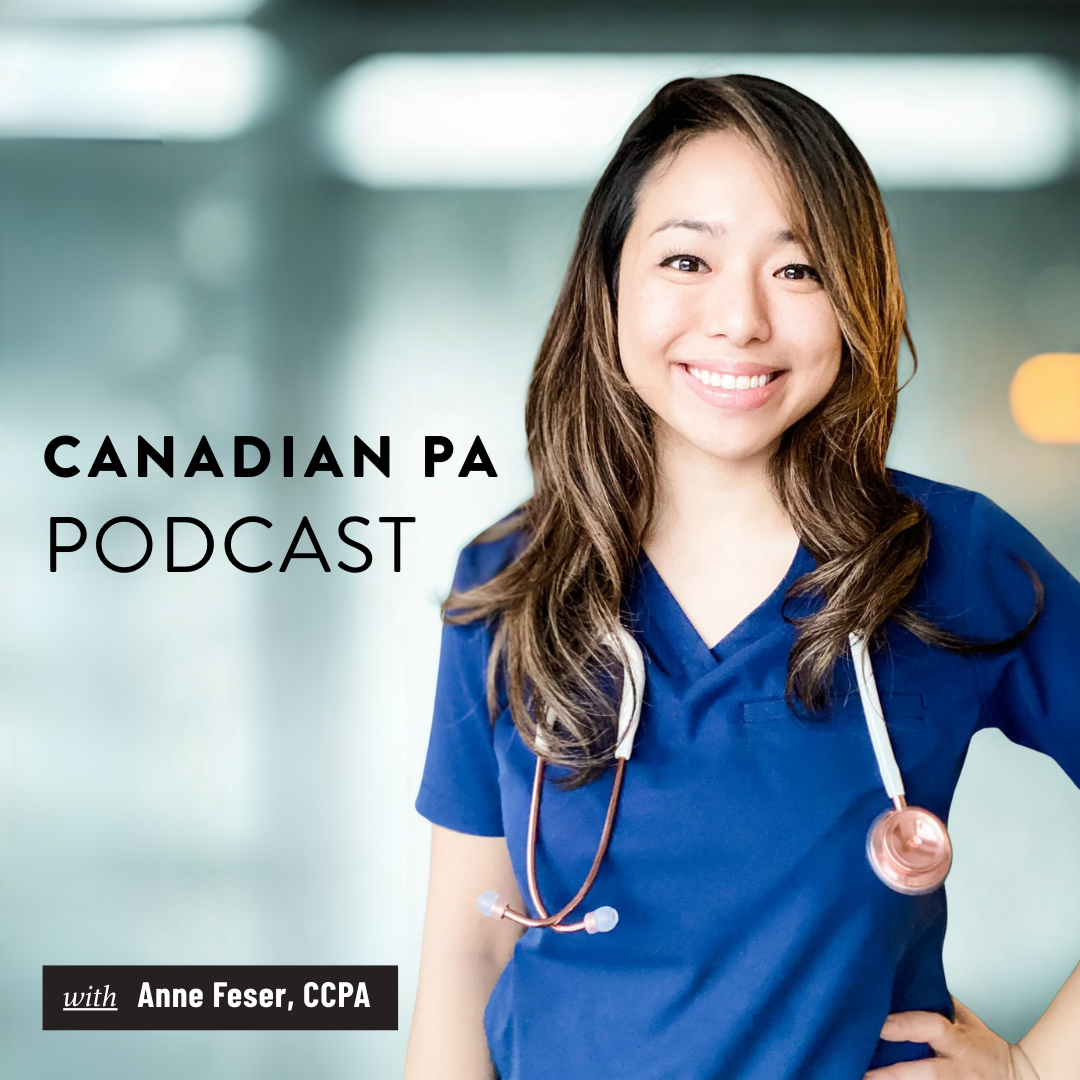
Episode #3: Kirsten, PA in Neurosurgery
Kirsten had applied to several PA positions, including general surgery and Orthopaedic Surgery that did not work out. Then she got a call over the Christmas holidays about a Neurosurgery department that wanted to hire a PA but had no funding to offer. She agreed to the meeting anyway, and by the next morning the department had secured funding for her role as part of the Alberta PA Demonstration project, and she had a job offer.
What followed was a steep learning curve into one of the more demanding specialties a PA can work in. Kirsten discusses practical realities of a neurosurgery PA role including managing a ward of 30 to 50 patients, performing drain procedures, first assisting in the OR, and spending a meaningful portion of each day with families navigating catastrophic diagnoses.
Kirsten also speaks to the broader picture of PA practice in Alberta, where regulation has cleared legislation but policy finalization is still underway, and where there is no PA training program yet (episode originally published in 2018, Alberta now has a PA Program!).
WHAT YOU’LL LEARNHow to position yourself for a PA role in a surgical specialty that has never hired a PA before
What a neurosurgery PA's daily responsibilities look like across ward management, family counseling, first assist in the operating room, and procedures
How to protect your mental health and build sustainable boundaries when working in high-acuity, with possibility of high morbidity specialties
What the current state of PA regulation and workforce development looks like in Alberta
GUEST BIOKirsten is a Canadian Certified Physician Assistant who built her career across two distinct worlds: a full military career that took her from British Columbia across the country, and a civilian PA practice she entered with deliberate intention. She came into the PA profession with a clear surgical interest, applied to multiple positions on graduation, and ultimately landed in neurosurgery through a demonstration project at her Alberta hospital after an unexpected call over the Christmas holidays.
She now works on a neurosurgery service alongside 12 neurosurgeons, managing a ward of 30 to 50 patients, performing procedures including drain management and lumbar drains, first assisting in the OR, and spending a significant portion of her time counseling families navigating devastating diagnoses. Her military background gave her a team-first orientation that translated directly into civilian hospital culture, and she credits that foundation for making the transition feel manageable.
Outside her clinical role, Kirsten is an active voice for PA advocacy in Alberta, where regulation has cleared legislation and is working toward final policy approval. She speaks at conferences to educate nurses and other health professionals about the PA role, mentors prospective PAs who reach out to shadow her, and keeps a close eye on the possibility of a PA training program eventually opening in the province.
ON THE GAPS THAT PAs FILL IN SURGICAL SPECIALTIES“The residents spend a lot of their time learning skills in the operating room. A loved one has a glioblastoma and the life expectancy is very poor — someone has to sit with that family and guide them through what comes next. That's where I am. About 20% of my time is counseling families.”
— Kirsten Luomala, CCPA, PA in Neurosurgery
ON LANDING A PA JOB IN NEUROSURGERY“I didn't get the other two positions I applied for — and then I was called over the Christmas holidays. Neurosurgery is looking for a PA. They have no funding. Would you be interested in meeting with them? I said I'd be willing to meet. The next morning they managed to find funding and I was offered the position”
— Kirsten Luomala, CCPA, PA in Neurosurgery
ON WORKING IN A HIGH ACUITY, HIGH MORBIDITY/MORTALITY SPECIALTY“You don't get very many good outcomes. Most of our cases are people dying of brain tumours or dealing with horrible traumas. So when we get that nice good news, when someone walks out of the hospital well, we really hold onto those.”
— Kirsten Luomala, CCPA, PA in Neurosurgery
ON WHAT KEEPS HER GOING“The most fulfilling part of this position is truly the team I work with. The nurses, social workers, unit clerks — everybody has everybody's back. That transition from a military team to a civilian team made this so much easier”
— Kirsten Luomala, CCPA, PA in Neurosurgery
ON NOT TAKING WORK HOME“You need to find a way to actually turn off your brain. Recognize that when you're not at the hospital, you're not talking about the hospital. And when it's weighing on you too much — find people to talk to. Because it can be taxing.”
— Kirsten Luomala, CCPA, PA in Neurosurgery
-
How Kirsten Landed in Neurosurgery
Kirsten [5:49] It actually is a unique story because I knew I wanted to go into something surgical. I was really looking at general surgery and orthopedic surgery. Unfortunately, because my husband is retired, I was not willing to take a risk of not getting a job. I wasn't retiring until I had a job.
Kirsten [6:10] I didn't get the other two positions I applied for, and I was called over the Christmas holidays and told that neurosurgery was looking for a PA. Would I be interested in meeting with them? They had no funding — it would just be a meeting. I said I'd be willing to meet.
Kirsten [6:26] They forwarded my resume, called me back, and said they'd love to meet. They told me the name of the head of the department, and ironically, his name is Dr. Ironic — he actually saved my middle daughter's life in 2003. When he saw the resume, he had no idea of that connection until we met for the interview. We went in, discussed how PAs could potentially benefit their department, and the next morning they managed to find funding through the demonstration project and I was offered the position.
The Department's Prior Experience with PAs
Anne [7:06] Had the physician had experience with a PA prior to you coming on?
Kirsten [7:11] Dr. Ronak had trained in the US, so he had worked with PAs down there, and he had actually been advocating to get PAs here in Alberta for a significant amount of time. Some of the partners in our department had also trained in the US and had really seen some successes down there, so they were quite interested in having a PA.
Integrating into Neurosurgery: The First Few Months
Anne [7:36] How did you find the transition in terms of integrating into civilian practice?
Kirsten [7:40] The first couple of months were quite challenging, partly because the residents I was working with had never worked with a PA before and none of them had trained in the States — they really didn't know what a PA was going to be about. The demonstration project had done a lot of legwork educating both the nurses and the physicians on what we could and couldn't do. And then of course there was the steep learning curve of neurosurgery itself.
Kirsten [8:19] The department had already had an international medical graduate as a hospitalist, and they had also had a nurse practitioner prior to me — and with those two individuals, it hadn't worked. So they needed somebody, but they weren't quite sure how this was going to fit. They were very determined to find solutions to make this a successful endeavor.
Orientation and Learning the Role
Anne [8:43] What kind of orientation did you receive when you started the job?
Kirsten [8:46] I spent the first month working alongside Dr. Ronak for the majority of the time, and then slowly integrated in with the residents. I would join them on morning rounds, see all the patients, shadow one of the senior residents on consult, shadow in the OR, and just learn some of the skills they needed me to have.
Anne [9:12] How long would you say it took before you started to feel really comfortable operating a little more autonomously?
Kirsten [9:19] I realized quickly that there was a real void when you're dealing with a surgical specialty — the residents spend a lot of their time learning skills in the operating room. In neurosurgery, we deal with people who often aren't having great outcomes, and their families are going through very difficult situations. A loved one has a glioblastoma, like Gord Downie's tumor, and the life expectancy is very poor. Or they've had a devastating trauma that's left their 20-year-old confined to a wheelchair and mentally incapacitated. So we spend a lot of time with families helping guide them through what the next steps are going to be. I'd say about 20% of my time is counseling families.
A Day in the Life: Neurosurgery PA Practice
Anne [10:18] Where do you spend the rest of your time?
Kirsten [10:19] The majority of my day is spent on the wards. I have probably between 30 and 50 patients depending on the time of year, workload, and how many staff are around. Majority of the time I'm doing a general hospitalist-type role. I do first assist when we're short residents, which can be anywhere from one day a week to two or three days a week, depending on the resident load. Consults are only on Fridays — that's the academic day for the residents. And then I spend the rest of the time studying and reading, trying to keep things up.
Anne [11:05] Do you do any procedures?
Kirsten [11:07] The majority of the drains — placing and removing drains, whether that's for a back, an external ventricular drain, subdural drains, lumbar drains. I'm now in the process of transitioning into learning how to put in an EVD, an external ventricular drain. We're one of the few neuro units that has its own ICU and our own intensivists, so we're also starting to transition into central lines and art lines and things like that.
Impact on the Neurosurgery Service
Anne [11:48] What difference have you noticed — or what difference has the hospital noticed — since adding you to the neurosurgery service?
Kirsten [11:54] Very similar to the study done out of Sunnybrook with the general surgery team — fewer surgeries being cancelled, because I'm able to free up beds earlier in the day and facilitate faster discharges. We've seen a decrease in the amount of complaints from families, just because there's been somebody who can actually sit down and talk with them and guide them through the process. The nurses are finding their demands are met more easily because there's somebody who can get onto the wards way sooner than the residents can.
Finding Fulfillment in a High-Stakes Specialty
Anne [12:35] Do you find the job fulfilling?
Kirsten [12:37] It's an extremely stressful job because you don't get very many good outcomes. Most of our cases are people dying of brain tumors or dealing with horrible traumas. So when we get that nice good news — when someone walks out of the hospital well — we really hold onto those. The most fulfilling part of this position is truly the team I work with. I work for 12 neurosurgeons and 3 pediatric neurosurgeons. I don't do pediatrics myself, but the pediatric neurosurgeons do adult procedures, and they are an extremely supportive, close-knit group. The nurses, social workers, unit clerks — everyone has everyone's back. That transition from a military team to a civilian team really made this much, much easier.
Work-Life Balance in a High-Acuity Role
Anne [13:42] Do you have any suggestions for someone interested in maintaining work-life balance while working in neurosurgery?
Kirsten [13:49] For anyone interested in specialties with those kinds of outcomes — palliative care, oncology, neurosurgery, even pediatrics — you need to find a way to disconnect from work. That could be throwing yourself into your family and their activities, or just taking an hour to unwind. Have a bath, a glass of wine, go for a run. It's about actually being able to turn off your brain and recognize that when you're not at the hospital, you're not talking about the hospital. And when it's weighing on you too much, find people to talk to, because it can be taxing.
PA Practice in Alberta: The Landscape and Advocacy
Anne [14:39] It sounds like you're not originally from Alberta?
Kirsten [14:44] I'm originally from British Columbia, and I've pretty much lived from one end of the country to the other over my military career. We chose to come back to Alberta because of the healthcare supports it offers for one of our children.
Anne [15:00] How do you find the environment with regards to welcoming PAs?
Kirsten [15:03] Extremely welcoming. Initially there was a little bit of resistance from people who didn't know what we did, but there's been a lot of advocacy and education around it. I've just been invited to my third conference to speak to a group of nurses about PAs. The word is getting out that we're here and we're a tool that can be used. For the most part, it's been very welcoming.
Anne [15:40] Is there a big supply of PAs in Alberta?
Kirsten [15:42] No. Some of the PAs we are getting are from Manitoba and Ontario. I think our supply will increase when and if they ever open a school here — that hasn't been finalized yet. The interest is there. I've had a few potential PAs reach out to shadow me at work and find out about the profession. I have a lot of questions from nurses who are very interested in eventually becoming PAs. The interest is there — it's just a matter of getting to the point where we have a school here.
Anne [16:20] Is Alberta regulated?
Kirsten [16:21] The regulation piece has been approved in legislation. What we're waiting for now is all the policies to be finalized by all the interested parties — the Medical Association of Alberta, the nurses, pharmaceuticals — all of them having a look at it and then having it go back to Parliament for finalization. The last piece I've been told is we're expecting that to be finalized this year.
Anne [16:49] How are you involved in PA advocacy?
Kirsten [16:51] I'd like to be involved even more. I really do think our profession needs that. It's about finding those opportunities to get out there and talk to people. The more we educate people — our patients, our families, other medical staff — the more we can advocate for ourselves. There hasn't been a ton of formal advocacy work to do in Alberta yet, but I'm often talking to my friends still living in BC and encouraging them to go to their members of legislative assembly to fight for PAs. I think we have a lot to offer across the country.
Anne [17:31] You actually answered all of my questions. Was there anything else you wanted to add, anything we didn't cover?
Kirsten [17:41] Interesting times ahead of us.
Anne [17:43] Absolutely.